Saturday, August 15, 2020

Rebooting Economy XV: Why shadow banking should worry policymakers in India and elsewhere

RBI has warned that economic disruptions may intensify systemic risks to India's financial sector primarily because NBFCs remain vulnerable with their deteriorating asset quality and reluctance of the market to lend them money. On the global front, there is little to cheer about shadow banking

twitter-logoPrasanna Mohanty | August 11, 2020 | Updated 19:11 IST
Rebooting Economy XV: Why shadow banking should worry policymakers in India and elsewhere
Shadow banking not only poses a threat to India but is equally a risk to the global financial order

There is no escaping the long shadows of shadow banking firms in India in the time of pandemic-induced economic disruptions.  

The banking regulator RBI issued a clear warning on July 24, in its Fiscal Stability Report, that the economic disruptions may intensify risks to its shadow banking firms, the Non-Banking Financial Companies (NBFCs), "and consequently" the systemic risks to the entire financial sector.

Threat to India's financial system

The threats to the NBFCs come from two sources: (i) their deteriorating asset quality and (ii) continued reluctance of market to lend money in the aftermath of implosion in two leading NBFC players, Infrastructure Leasing & Financial Services Limited (IL&FS) and Dewan Housing Finance Corporation Ltd (DHFL) in 2018 and 2019. Both were taken over by the RBI for loan defaults and now face bankruptcy proceedings.

The RBI report explained the risks even while saying that the overall outlook remained stable.  

It said: "Stress on non-banking financial companies and co-operative banks, that had mounted in the wake of credit events in 2019, has been exacerbated by risk aversion and flight to safety among banks, leading to funding constraints and differentiation in market access. The outlook remains clouded with considerable uncertainty as the pandemic takes its toll."

About 50% of the NBFCs' aggregate assets were under the moratorium on loan repayment by the end of April. Banks, which have been fighting shy of lending directly to the industry because of growing threat of bad loans (non-performing assets or NPAs), increased their lending to the NBFCs in recent years, as a result of which bank lending accounted for 28.9% of the total NBFC borrowings in December 2019 - up from 23.1% in March 2017.  

The RBI noted that notwithstanding this support from banks, the real risks to the NBFCs' liquidity come from declining market borrowings. It said that under the stress tests, 11.2% to 19.5% of NBFCs would not be able to comply with the minimum regulatory capital requirements (CRAR) of 15%.

The following graph maps the NBFCs' assets quality (GNPA and NNPA ratios) and capital-to-risk-assets ratio (CRAR) since FY14.  

In the meanwhile, the NBFCs have grown in influence, as is evident from the RBI data mapped below, against the GDP (at constant prices).

Shadow banking not only poses a threat to India but is equally a risk to the global financial order. For better appreciation, the 2007-08 financial crisis needs to be revisited.

Central role of shadow banking in 2007-08 financial meltdowns  

In 2017, the International Monetary Fund (IMF) released a special edition of its magazine 'Finance & Development', evocatively titled "Back to Basics". In one of the chapters, its economist, Laura E Kodres explained how shadow banks played a central role in the crisis of 2007-08.  

She wrote: "Shadow banks first caught the attention of many experts because of their growing role in turning home mortgages into securities. The "securitisation chain" started with the origination of a mortgage that then was bought and sold by one or more financial entities until it ended up part of a package of mortgage loans used to back a security that was sold to investors. The value of the security was related to the value of the mortgage loans in the package, and the interest on a mortgage-backed security was paid from the interest and principal homeowners paid on their mortgage loans. Almost every step from creation of the mortgage to sale the security took place outside the direct view of regulators."

She explained that the problem arose when investors turned skittish about the "real worth" of the longer-term assets of shadow banks and many decided to withdraw at the same time. The shadow banks went into "fire sells" to meet the demand, putting other financial institutions in danger because of their inter-connectedness. Most importantly, it caught "real banks" (traditional or commercial banks) on the wrong foot because "some shadow banks were controlled by commercial banks".  

Whatever the logic of traditional or commercial banks may be, for running or promoting shadow banking, the real motive seemingly was to escape regulatory oversight and make higher profits.  

In fact, that is precisely how shadow banks emerged as big and powerful players in 1980s - the era marked by neoliberal (radical right) economics in which profit-making became the driving force of businesses.

Prof. Nouriel Roubini of the New York University, better known as "Dr. Doom" for forewarning the impending "US housing burst" in 2006 and also predicting its recessionary impact world over, explained the emergence of shadow banking in his 2010 book, "Crisis Economics" (co-authored with Prof. Stephen Mihm of the University of Georgia). (Former RBI Governor Raghuram Rajan too had warned against the housing bubble.)

The authors wrote: "A growing number of people who joined the financial services industry from the 1980s onward realised that they could make plenty of money, so long as they were willing to walk the banking tightrope without a safety net underneath. There were ways to conduct banking free of regulations, but also free of the protections afforded ordinary banks. So began a game of "regulatory arbitrage," the purposeful evasion of regulations in pursuit of higher profits. This quest gave rise to the shadow banks."

Shadow banking, in the form of informal credit, has always existed outside regulatory oversight, like moneylenders providing credit to villagers for example, but it never threatened the world order in the way it did in the run-up to the 2007-08 financial crisis.  

Enduring overall growth in shadow banking

When the world woke up and started monitoring shadow banking, Kodres recorded the growth in their assets. In 2015, she wrote, their assets in the US was 28% of the total financial sector (down from 32% in 2011); in the euro area, it was 33% (up from 32% in 2011) and globally they accounted for $92 trillion (up from $62 trillion in 2007 and $59 trillion during the crisis).

One big initiative to monitor shadow banking was the multinational Financial Stability Board (FSB), set up in 2011. India is a part of this initiative.  

But Kodres was not happy. She commented: "The authorities (monitoring shadow banking) are making progress, but they work in the shadows themselves - trying to piece together disparate and incomplete data to see what, if any, systemic risks are associated with the various activities, entities, and instruments that comprise the shadow banking system."

Initially, the FSB defined shadow banks broadly to include all entities "outside the regulated banking system that perform core banking function", which meant credit intermediation (taking money from savers and lending it to borrowers) and they were called Non-Banking Financial Intermediation (NBFI).  

In its latest report of January 2020, the FSB divided those into three categories: (a) MUNFI (Monitoring Universe of Non-bank Financial Intermediation): "broad measure" of all NBFIs that are not central banks, banks or public financial institutions (b) OFIs (Other Financial Intermediaries): a subset of MUNFI that excludes insurance corporations, pension funds or financial auxiliaries and (c) NBFIs: "narrow measure" of NBFI comprising of non-banks that authorities have identified as the ones that may pose bank-like financial stability risks and/or regulatory arbitrage.

The NBFIs (narrow measure) are the ones identified as posing systemic risks.

Heightened systemic risks from shadow banking  

The 2020 FSB report shows that global estimates for the MUNFI assets stood at $183.6 trillion in 2018 or 49% of the total financial assets ($379 trillion). Of this, OFIs accounted for $114.3 trillion (30% of the total); NBFI for $50.9 trillion (13.4% of the total), and the rest for $18 trillion.

The FSB 2020 report says the "systemic risk" comes from activities that are "typically performed by banks, such as maturity/liquidity transformation and the creation of leverage".  

The alarming aspect of the NBFI is that it is growing.  

The FSB 2020 report says it "has grown faster than GDP since 2012, increasing to 77% of all participating jurisdictions' GDP in 2018 from 64% in 2012. This trend is observed in most jurisdictions".

The FSB measures 29 jurisdictions (including India and China), representing over 80% of global GDP.  

Growth in India's shadow banking (NBFCs)

What does the FSB of 2020 say about India? (India's NBFCs correspond to the NBFIs.)  

It shows India is an outlier - in a negative way.  

Here are two examples.

India recorded 22.4% growth in OFI assets in 2018, while the global growth was 0.4%.

As for NBFIs (NBFCs in India), a major drawback is their over-dependence on short-term funding for long-term lending (technically called EF2 function).  

Globally, such funding accounted for 7% of the total in 2018 and it grew 6.9%. In sharp contrast, India recorded a 17.4% growth in 2018. As for its share in the total NBFC funding, the RBI's banking trend report released in December 2017 revealed that it stood at an unbelievably high of 99.7%.

In the NBFC context, short-term means a period of up to three years and long-term for up to 15 years, as in the case of housing and infrastructure loans. Why such anomaly continues in the NBFCs' functioning is an abiding mystery.

Little wonder, when the NBFC crisis hit India in 2018 and 2019, the two big players to implode (IL&FS and DHIL) were associated with infrastructure and housing sectors, though this is only one part of the saga.

Rebooting Economy XIV: Debt vs equity; why businesses are debt-driven

 Most governments across the world incentivise debts to drive business even when it leads to over-borrowing, economic instability, tax evasion and adversely impacts investment in public goods. In contrast, equity-driven business has none of these ill-effects, produces better economic outcomes too

twitter-logoPrasanna Mohanty | August 6, 2020 | Updated 18:42 IST
Rebooting Economy XIV: Debt vs equity; why businesses are debt-driven
Since businesses need capital, tax-free debt provides a cheaper source, lowers cost of production and improves competitiveness

That debt-driven growth model is deeply flawed and comes at a high cost to well-being of people (public goods) has been well recognised, especially after the US housing bubble fuelled by cheap debt burst that led to global recession in 2007-2008.  

Yet, most governments around the world persist with the debt bias in two ways: (i) taxing the returns on equity (dividend) but exempting the returns on debt (interest) and (ii) keeping interest rates low to push debt.  

Equity and debt (loan) being the two ways of mobilising capital, when equity is dis-incentivised, businesses opt for debt. There is considerable literature on the dangers of debt-driven business. It leads to over-borrowing, thereby increasing the probability of economic instability and crisis; reduces tax base; diverts public money from being invested in public goods (to raise standards of living); incentivises tax evasion and facilitates private gains with public money.

Also Read: Rebooting Economy XIII: Why Indian corporates are debt-ridden

The debt bias has seeped so deep into business thinking that few realise it was a distortion introduced 102 years ago (in 1918) by the US Congress without explanation, which was then copied worldwide.

Let's begin the story backward from 2020.

Business case for debt-driven entrepreneurship

There is a good business case for debt-driven businesses.

Most tax laws allow tax-free debt. This is by allowing interest paid on debts (loans) deductible before profit is calculated, and treating interest paid as a cost to business.  

Since businesses need capital, tax-free debt provides a cheaper source, lowers cost of production and improves competitiveness. On the other hand, dividend is not tax deductible (dividend is paid after tax is paid) because it is treated as income to business. Dividend is a division of income.

Most governments also sweeten debt by reducing interest rates.  

Some governments, like the US, have kept interest rate near zero (0.25%) for years, even after the experience of 2000-01 dot-com bubble and 2007-08 housing bubble which, when burst, led to millions of job losses, wiped out pension savings of a few more millions and demise of big financial institutions, some of which were bailed out with public money.

Many countries, like India, give tax concessions, regulatory and administrative incentives (called "ease of doing business") to attract FDI. To encourage domestic businesses, India and the US have cut corporate tax and lowered interest rates to borrow more. India's banking regulator RBI cut repo rate from 6% in April 2018 to 3.5% in May 2020 and CRR to 3% in FY21.

Besides, India offers two additional advantages on borrowing.

First, debt default, even if wilful, is written off routinely as NPA without too many questions. The RBI protects defaulters by not naming them or revealing NPAs being write-offs since 2019 and erasing earlier data from its database. (For more read 'Rebooting Economy IX: Why is private sector dependent on public money in times of crisis? ').

Second, it diluted the Insolvency and Bankruptcy Code (IBC) of 2018, as former RBI Governor Urjit Patel revealed recently, opening the door for more loan abuse.  

Further, India is contemplating one-time restructuring of stressed debts, the failure of which led to the IBC in the first place and/or extending moratorium on debt repayment beyond August 31, even after the RBI warned on July 24 that bad loans (GNPAs) of the Scheduled Commercial Banks (SCBs) could go up from 8.5% in FY20 to 14.7% in FY21.  

India's largest public sector bank SBI issued a warning on August 3, stating that extension of moratorium would "do more harm than good". It gave two examples.  

First, 70% of the total moratorium was availed by corporations rated 'A 'and above - those who can easily repay with "comfortable debt-equity ratio". Second, consumer loans declined by Rs 53,023 crore in the current fiscal but "consumer leverage in lieu of exposure to stock market" increased by Rs 469 crore that "could be a potential source of financial instability".

High cost of debt bias and debt-driven business

The negative effect of debt bias and debt-driven business model is well recognised.

Economist Joseph Stiglitz wrote in his paper of 2017, "Alternatives to Debt-driven Growth: Continuing in China's 40 year of Reform", that low-interest and tax-free debt regime lead to "market irrationalities that typically then appear in the pricing of risk: a search for yield drives down risk premia, and there is systematically excessive risk-taking".

A 2011 paper of the International Monetary Fund (IMF), "Tax Biases to Debt Finance: Assessing the Problem, Finding Solutions", asserted: "Legal, administrative, and economic considerations offer no compelling ground to systematically favor debt over equity finance."  

It said the evidence showed debt bias "creates significant inequities, complexities, and economic distortions" by leading to inefficiently high debt-to-equity ratios in corporations; discrimination against innovative growth firms; impeding stronger economic growth; threat to public revenues due to tax evasion/avoidance and erosion in tax base. The cost to public welfare, though long recognised, could be far larger than previously thought because of the 2007-08 experience, it added.

It further said businesses respond to the incentives of debt bias more over time (i) leading to over-borrowing and too much risk taking by financial firms (ii) builds up excessive debts in banking system and (iii) increases chances of defaults and financial crisis and magnifies the depth of crisis, especially due to systemic effects of bank failure.  

It highlighted three legal flaws causing debt bias: (a) debt holders have legal right to pre-fixed returns, irrespective of financial position but equity holders receive variable returns, based on performance of firms (b) debt holders have a prior claim to the firm's assets in case of insolvency, equity receive only "residual" claims after debt is repaid (c) suppliers of debt have no control rights over the firm, suppliers of equity do.

There are other downsides.

Tax-free debt comes at a very high cost to economies.

In 2015, The Economist pointed out that before the global recession hit in 2007, "tax foregone" on debt or "debt subsidy" cost the US 5% of its GDP or $725 billion and Europe 3% of its GDP or $510 billion.  

In 2015, after the US had reduced interest rates "close to zero", tax subsidy still cost it more than 2% of GDP - an amount it spends on "all its policies to help the poor".

Another of its articles at the time called debt subsidy provided all over the world a "senseless subsidy" and "bad idea".  

How much does it cost India? There is no data or known estimates.  

There are other costs to debt bias too.

How debt bias incentivises tax evasion

The Tax Justice Network (TJN), an international network doing pioneering work to prevent tax evasion, explains mechanisms adopted by multinational companies (MNCs), private equity firms (PEs) and individuals exploit debt bias for tax evasion.

About MNCs, it says: An MNC first sets up a finance company in tax haven, which then lends money (internal debt) to other company/companies owned by the same MNC. Interest is paid to the tax haven-based company, thus moving money from higher tax countries to lower or no tax jurisdictions.  

This practice is the order of the day. Global efforts to battle it since 2012 have failed to produce meaningful results.  

The OECD-G20's BEPS initiative to check tax evasion started in 2012 and India's own General Anti Avoidance Rules (GAAR) was framed in 2012. Both are cosmetic exercises and have produced no results so far. India is yet to operationalise GAAR, extending the date of enforcement yearly. The next date is April 1, 2021. (For ore read 'Taxing the untaxed VIII: How India and multilateral bodies are fighting tax avoidance )

In case of external debt, TJN explained the mechanism: A company is first bought using borrowed money by a tax-haven based company. The debt is then transferred to the company bought, burdening it and lowering its value. After the debt is paid and normal level of profit returns (often accompanied with drastic cut in services, staff and wages) this company becomes more valuable, its shares are sold off to a tax haven holding company created for the purpose, which makes capital gains tax free. Or the company is sold off at a profit.

This is how private equity (PE) firms operate. When the plans fail, as it did in case of the UK's care homes, the UK government had to bail out the care facilities (for the old and infirm) with public money. (For more read 'Rebooting Economy XII: Is private sector inherently more efficient than public sector? ')

Advantages of incentivising equity and equity-driven business

The tax bias against dividend ensures that even if the dividend market is fully developed, businesses seek debt for capital. (In India, dividend was earlier taxable for both enterprises and equity holders (shareholders) but after the 2020 budget it is taxable only for equity holders, not businesses.)  

There is no dispute that equity-driven business is a better business.

Stiglitz wrote in his 2017 paper: "Equity has a marked advantage over debt. When the fortunes of the company turn out to be less than expected, perhaps because of a cyclical downturn, perhaps because of unanticipated changes in market conditions, there doesn't have to be a costly debt restructuring."  

He did caution though: "But with equity, the profits are supposed to be shared equitably among all the shareholders, and managers and the original owners often have the means of shifting profits towards themselves. But if enough firms do this (profit shifting to owners), there will be no confidence in the equity markets. Confidence in the equity market can only be assured through good norms."

Arguing the case for equity over debt, the IMF's 2011 paper said: "... introducing a deduction for corporate equity has better prospects... Apart from eliminating debt bias, such an allowance would bring other important economic benefits, such as increased investment, higher wages, and higher economic growth."

It pointed out that countries like Belgium, Brazil and Latvia successfully introduced variants of the allowance for corporate equity, suggesting that it was "not only conceptually desirable and practically feasible".

Has debt-driven business model delivered?

After 1970s' neoliberal (radical right) push by the World Bank and IMF, another dimension was added to tax laws: drastic cut in corporate tax. In India, for example, it is lower than individual income tax post-2019 tax cut.

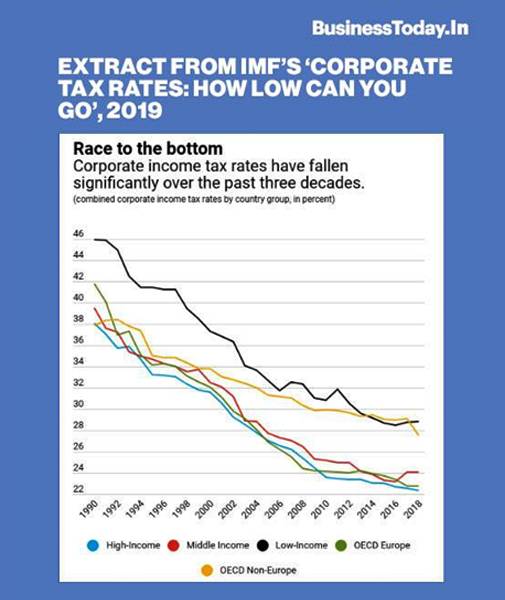
Such has been the drop in corporate tax that a 2019 internal paper of the IMF warned developing countries against its serious consequences: lowering government resources to boost growth and reduce poverty, undermining the fairness of tax system and encouraging tax avoidance and tax abuse.

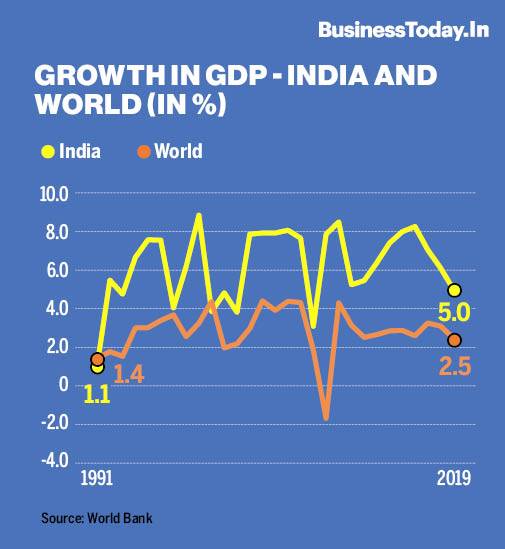
The following graph, taken from this IMF paper shows the drop in corporate tax and the next one shows the GDP growth globally and in India during the corresponding years.

Has worldwide corporate tax cut produced high growth it is premised on?  

The US and India cut corporate tax in 2017 and 2019, respectively, by repeating the bizarre neoliberal economic concepts: tax cuts to rich benefits the non-rich.  

In 2019, the US Congress discovered that the corporate tax cut led to stock markets, setting a new record in stock buybacks at $1 trillion. India never tried to find out, but its stock markets are booming even when the COVID-19 cases repeatedly crossed 50,000-mark per day, taking the total cases to over 19.6 lakh (as on August 6) and the economy continues to remain depressed.

On the other hand, economic history shows that during the golden age of capitalism between 1950s and 1970s, corporate tax rates were extremely high, unthinkable by today's standards. The average top corporate tax rate was 70-80% in the US and 99.25-80% in the UK. (For ore read 'Deconstructing Neoliberalism III: Why neoliberalism calls for a rethink ')

Alternatives to debt-driven business model

By now it is clear that equity-driven business is a better one.

While advocating it, Stiglitz suggested two measures in his 2017 paper: greater reliance on (a) taxation of public sector (to bring equity by taxing the rich) and (b) equity-driven model for private sector.

The IMF's 2011 paper called for complete dismantling of tax-free debt regime to ensure equal treatment of debt (loans) and equity. This would have several advantages: broaden tax base (debt is no more tax free), allow lowering of tax rates (attracting FDI); shift "tax burden away from economic rents towards marginal investment". However, when all countries pursue the same policy, the benefits will disappear.

It also forwarded an argument for going beyond neutrality to penalise debt financing for adverse spill-over effects (systemic failure and contagion effects). In this, an allowance on equity is meant to obtain neutrality first and then a higher tax debt to discourage sectors where externalities are most relevant: financial sector.

It concluded: "These two pillars (penalising debt and incentivising equity) together are also attractive from budgetary and political perspectives since they combine a lower tax burden for firms that invest in new assets with a higher tax burden for firms that feature excessive levels of debt. The budgetary cost of the reform can thus remain limited and the tax burden shifted from desirable to harmful behavior."

Now is the time to answer another important question: How did debt turn tax-free?  

Why and how debt became completely tax free  

Here is what happened 102 years ago, in 1918.

Duke University professor Alvin C Warren, Jr narrated this story in his paper, "The Corporate Interest Deduction: A Policy Evaluation", published in the Yale Law Journal in 1974.

He wrote: "The unlimited deduction for corporate interest payments originated in 1918 as a temporary measure designed to equalise the effects of the World War I excess profits tax. Before 1918, only limited offsets against corporate income were granted for interest payments, apparently because Congress feared that corporations would try to avoid taxation by substituting bonds for stock."

He went on to add: "When the excess profits tax was repealed in 1921, the full interest deduction was retained as part of, the corporate income tax, without any explanation by Congress in the legislative history."

"Excess profits tax" was imposed after World War I to generate additional resources for reconstruction of war ravaged Europe that spread to other parts of the world. The logic being: some traders and businesses (like food and ammunitions) profiteered and recorded windfall gains due to war-time situation (scarcity, inflation, restrictions on movement of goods) without really bringing value additions and thus branded "unearned".  

The concept originated in Denmark and Sweden in 1915 and by 2017 had spread to 13 countries "like the Spanish influenza" as another American economist Carl C. Plehn wrote in his 1920 paper "War Profits and Excess Profits Taxes".

When the US allowed "unlimited deduction" of interest on debts in 1918, it was justified on the ground that war time "excess profits" were earned on "invested capital", but "borrowed money" (debt) did not come in the definition of "invested capital". So, the US Congress reasoned that it was "only fair" that interest on corporate indebtedness be fully deductible.  

Warren's paper tells that tax discrimination of debt and equity is an old concept, as old as the accounting concepts of what are cost and income to a business. Interest on debt has always been clubbed with wages, rent and supplies as a cost, while dividend has always been a "division of profit" or income, not an expense.

The logic endures and so does the distortion.


Rebooting Economy XIII: Why Indian corporates are debt-ridden

 India faces a fresh threat of NPAs with RBI warning dramatic rise in loan default rate from 8.5% in FY20 to 14.7% in FY21. A global study shows the Indian corporate sector was most debt-stressed with 43% of long-term loans vulnerable to default even before the COVID-19 pandemic hit

twitter-logoPrasanna Mohanty | August 5, 2020 | Updated 21:51 IST
Rebooting Economy XIII: Why Indian corporates are debt-ridden
Even before the COVID-19 pandemic hit, the world was witnessing a phenomenal rise in debt against which multiple agencies were issuing warnings

On July 31, 2020, Finance Minister Nirmala Sitharaman announced that talks were on with the banking regulator RBI to extend the moratorium on repayments and restructuring of borrowings beyond August 31.

This was after the RBI released its Financial Stability Report on July 24 issuing a dire warning: Macro stress tests indicate that the Gross NPA (GNPA) ratio of the Scheduled Commercial Banks (SCBs) could rise from 8.5% in FY20 to 12.5% under baseline scenario and 14.7% under very severe stress in FY21 because of the lockdown-induced economic disruptions.  

Although Sitharaman's statement came in the context of hospitality industry, extension of moratorium or restructuring of borrowings can never be restricted to one sector since many others, like aviation and MSMEs, are hit equally hard too.

Evidence shows such remedies are fraught with damaging consequences for the economy by worsening the debt crisis and weakening banking finances. But before getting there here is how big the debt crisis is.

Also Read: Rebooting Economy XII: Is private sector inherently more efficient than public sector?

What do GNPA ratios of 12.5% to 14.7% mean to Indian economy?

The RBI has stopped providing data on the non-performing assets (NPAs) it is writing off every year, thereby blunting accountability and transparency in its operations. It hasn't revealed the GNPA for FY20 in absolute number (in Rs crore) either, but says the GNPA ratio (GNPA/Gross Advances) in FY20 is 8.5%.  

But this can be easily calculated. Here is how.

The simple averages of the GNPAs and Gross Advances of the SCBs for the previous five years between FY15 and FY19 (for which data is available in the RBI database) work out to be Rs 7.4 lakh crore and Rs 87.5 crore, respectively.  

Let us assume these average holds for FY20.  

Now the GNPA ratio for FY20 works out to be 8.5%, perfectly matching with the RBI's declaration (that is perhaps how the RBI calculated it too).

Assume also that the FY20 levels of GNPA and Gross Advance hold true for FY21. What would the projected rise in the GNPA ratios to 12.5% and 14.7% mean for the GNPA in absolute terms?   

The GNPAs for FY21 would be Rs 11 lakh crore and Rs 13 lakh crore, respectively.  

These are very big numbers - 7.5% to 9% of the FY20 GDP (GDP at constant prices for FY20 is Rs 145.66 lakh crore, according to the NSO's May 29, 2020 statement).

Imagine there is no GNPA for FY21. Banks would not have to set aside money as contingency cover. Also imagine if a part of the GNPA is not written off, partially or fully, in subsequent years.  

The entire amount of Rs 11-13 lakh crore plus banks' provisioning against it would be available and work to revive the lockdown-hit economy.  

Two important facts should be kept in mind here: (i) the RBI routinely writes of NPAs even when it is wilful (those who can pay but don't are classified as "wilful defaulters"), letting private corporates routinely get away with public money and (ii) the public sector banks (PSBs) account for more than 80% of total GNPAs in the SCBs (86% in FY18), which are compensated (recapitalised) later with more public money. (For more read 'Rebooting Economy IX: Why is private sector dependent on public money in times of crisis? ')

Writing off NPAs is a double loss to the economy: (i) loss of public money (deposits) in the SCBs (Rs 11-13 lakh crore) and (ii) the subsequent recapitalisation of PSBs with more public money (to the extent the NPAs are written off).

Dire warning against growing debt across world

Even before the pandemic hit, the world was witnessing a phenomenal rise in debt against which multiple agencies were issuing warnings. The lockdown would surely be worsening it.

For example, Kristalina Georgieva, managing director of the International Monetary Fund (IMF), warned on November 7, 2019, that the global debt - both public and private taken together - had reached an all-time high of $188 trillion or 230% of global output (GDP).

The IMF had organised a conference in Washington to discuss the development which she was addressing.

She cautioned: "Think of the devastating effects of unsustainable credit booms, including in the run-up to the global financial crisis (2007-08).A major driver of this build-up is the private sector, which currently makes up almost two-thirds of the total debt level."

She went on to explain: "But that is only part of the story...Remember: the build-up of public debt has a lot to do with the policy response to the 2008 financial crisis - when private debt moved to public balance sheets, especially in advanced economies. Recent IMF staff research shows that direct public support to financial institutions (banks and others) alone amounted to $1.6 trillion during the 2008 crisis."

Writing off NPAs (private businesses' loan defaults) by the RBI similarly shifts private debts to public accounts. India witnessed rapid lending in recent years - target-driven MUDRA loans and continuous lowering of interest rates that endured in the post-lockdown period. More than 90% of India's economic package of Rs 21 lakh crore consists of facilitating credit or liquidity infusion. (For more read 'Coronavirus Lockdown XVI: Why India should be wary of excessive push for liquidity or credit )

Here is the latest update on global and Indian debts.

The Washington-based Institute of International Finance (IIF), an association of financial industries, provides debt positions four times a year. Last updated in July 2020, its data is presented in the following graph, using only the debt position as on March 1 of every financial year.

The data shows, the total global debt stood at $258 trillion on March 1, 2020, which was 331% of the global output (GDP) - up from $184.4 or trillion 10 years earlier on March 1, 2010. Private sector debt accounted for 73% of the total GDP or $188 trillion (it includes household debt of $48.1 trillion).

What about India?

The IIF provides data for India only in terms of GDP, not in absolute value. Its data shows the total debt stood at 130% of the GDP in the January-March 2020 quarter. India's government debt stood at 69% of the GDP and that its private sector 61%. But that is only one part of the story.   

Indian businesses show highest debt-stress level  

The US management consultancy firm McKinsey & Company had warned about debt-stress in corporate entities in its July 2019 report, "Signs of stress in the Asian financial system".

It singled out countries like India, where it said the signal was "ominous" and called for monetary policy reviews and preventive actions.  

The report showed India's corporate sector had the highest level of debt-stress in the world in 2017 with 43% of long-term loans facing potential default (interest coverage ratio of less than 1.5) - a rise of 30% from 2007. This is far more than 37% for China but India never attracted the kind of global attention China did.

It further pointed out that the corporate debt-stress was spread across sectors: industrial (capital goods, commercial professional services, transportation etc.), utilities, energy, real estate, and materials (in decreasing order).

Though this graph doesn't differentiate between public and private sector corporates, data from the bankruptcy proceedings (under the Insolvency and Bankruptcy Code) and other financial reports show that debt stress is predominant in the private sector.

The McKinsey report also highlighted a structural weakness in India's lending system that remains unaddressed as yet: high-risk lending by poorly regulated non-banking financial institutions (NBFCs).

It said: "In India, while (regulated) banks reduced lending as defaults showed signs of growing around 2014, nonbank financial intermediaries continued to lend. The Reserve Bank of India, India's central bank, estimates that 99.7 percent of nonbank finance companies (NBFCs) and housing companies make long-term loans against short-term funding."

That India's corporate debt-stress remains elevated has been flagged off by the global financial services agency Credit Suisse for at least three consecutive years since FY17.

It's "India Corporate Health Tracker" of August 2019 shows that barring a few, all familiar big private business houses figure in the list of 49 "chronically stressed" corporates (interest cover ratio of less than 1 for a period of 1 to 12 quarters).  

The names include one or more entities belonging to the Reliance, Tata and Adani stables. A few are public sector entities, like the SAIL, MTNL, Shipping Corporation, Mangalore Refinery, Petrochemicals, and Chennai Petroleum. Debt stress is spread across sectors like infrastructure, manufacturing, telecom, power, metals, textiles, etc.  

The debt of these 49 chronically stressed companies has been consistently rising from Rs 8.9 lakh crore in FY17 to Rs 9.1 lakh crore in FY 18 and Rs 10.2 lakh crore in FY19.  

Why Indian corporates are debt-ridden?

The findings of the McKinsey and Credit Suisse reports raise many fundamental questions.

Why are India's big and apparently successful corporate entities debt-ridden? Why don't they use their own money - accumulated profits and wealth over the years -or infuse equity for establishing new businesses or expanding existing ones? Are they really stressed or is it a deliberate ploy to misappropriate public money?  

The last question arises not only because the Indian government and RBI routinely write off corporate loans as NPAs (even if wilful) without question (the data is also kept hidden from public eye) but also because a series of corporate frauds have flooded out in the past couple of years: PMC, PNB, IL&FS, HDIL, DHFL, Yes Bank, ICICI-Videocon, and NSEL scams to name some.

Some of these scams reveal years of fraudulent financial dealings, others demonstrate outright loot of public money (for example, Nirav Modi, Mehul Choksi, Vijay Mallya, Jatin Mehta and many others fled India after pocketing public money).

In all, 36 such businessmen fled in recent years, the Enforcement Directorate (ED) told a court. With the Insolvency and Bankruptcy Code now diluted, the misappropriation of public money is more likely. (For more, read 'Rebooting Economy XI: Why are private companies so prone to financial frauds? ')

Leaving aside malfeasance, debt-driven businesses are a common phenomenon. With the economic slowdown, the chances of defaults are now heightened with an already debt-stressed corporate sector.

Moratorium and restructuring of loans are bad ideas

Should the RBI then continue lowering interest rates to push supply-driven-credit? The repo rate (rate at which the RBI lends to banks) has fallen from 6% in April 2018 to 3.5% in May 2020, the capital reserve ratio (CRR) is down to 3% for FY21 with no corresponding gain seen in the economy.  

Most of the liquidity gets parked in the RBI's reverse repo account and it is well known to bankers and policymakers. In effect, the RBI and government know liquidity infusion is a spectacular failure and yet the push for more of the same continues.

A day after the IMF's Kristalina Georgieva warned against the growing global debt, the main speaker of the event Jeremy Stein, a Harvard professor, issued a dire warning.

His presentation read: "Supply-driven credit booms - accompanied by aggressive pricing and erosion of credit quality - appear to play a big role in fluctuations in economic activity across a wide range of sample periods, countries, and institutional arrangements."  

It said such supply-side credit push brings "not just financial crises, but garden-variety recessions as well."

Not long ago, economist Joseph Stiglitz too had warned against supply-drive debt push: "...periods of rapid lending are often associated with bubbles like the tech bubble and the real estate bubbles in the US. (There is again typically a causal link: rapid lending helps create and sustain these bubbles.) Such bubbles make the assessment of risk more difficult."

Here is a warning from India's largest public sector bank SBI about extending moratorium on debt repayment.  

On August 3, 2020, its research paper said: (i) 70% of the total moratorium have been availed by corporates which are rated A and above - those who can easily repay with "comfortable debt-equity ratio" (those with comfortable debt-equity are spread across sectors like pharma, FMCG, chemicals, healthcare, consumer durable, auto, etc.) and (ii) consumer loans declined by Rs 53,023 crore in the current fiscal, but "consumer leverage in lieu of exposure to stock market" increased by Rs 469 crore that could be a potential source of financial instability".

It warned that a blanket extension of moratorium beyond August 31 would "do more harm than good".

As for restructuring of bad loans that the government talks of, the IBC was brought in in 2018 precisely because the earlier regime of restructuring was a disaster and ended up ever-greening bad loans and caused higher losses as more good public money was thrown after bad money year after year.

Here is more food for thought.

How does India's economic growth square up with growth in bank loans?

The following graph presents data from the RBI and NSO for a period of 15 years (FY06 to FY20).

The correlation seems tenuous, doesn't it? Thereby hangs another tale.

Saturday, August 1, 2020

Rebooting Economy XII: Is private sector inherently more efficient than public sector?

Global studies show ownership does not make enterprises efficient, factors like competition, autonomy, regulation and institutional development do. Evidence also shows that private sector thrives on public hand-outs in normal times and public bail-outs in crises

twitter-logoPrasanna Mohanty | August 1, 2020 | Updated 11:30 IST
Rebooting Economy XII: Is private sector inherently more efficient than public sector?
Private sector efficiency is a neoliberal economic construct pushed in 1970s by the Chicago school of economics to promote private enterprises and limit the role of state in running economies
Since 1970s it has been repeatedly said that the private sector is inherently efficient and hence the global emphasis on its growth, more often than not, at the cost of public sector. What evidence exists in academic studies and economic history to substantiate this?
Here we look at some of this evidence.
No ownership model is intrinsically more efficient 
In 2015, the United Nations Development Programme (UNDP) published a paper "Is the Private Sector more efficient? A cautionary tale" analysing all existing global studies on comparative efficiencies of public and private sectors with a view to assist in "achieving the UN Sustainable Development Goals (SDGs)" rolled out 2015 for the next 15 years.
It captured the substance and nature of the debate in its entirety, better than any known study. Its two important conclusions were: (i) "no model of ownership" - public, private or mixed - "is intrinsically more efficient" than the other and (ii) efficiency under all ownership models "depends on competition, regulation, autonomy and wider issues of institutional development". 
The third conclusion (the middle one in the box) was that the literature on comparisons lacks academic rigour, sector-specific, and often inconclusive.
It explained this conclusion: "Most literature comparing ownership models looks at specific service sector: health, education, water, sanitation, and so on. The literature that compares public and private provision, in general, tends to be made up of opinion pieces and lacks rigour in comparison to academic and policy studies. The rigorous literature that does exist suggests that efficiency depends on factors such as country context, the sector, the market the firm operates in and the firm's organisation, rather than ownership." 
This is primarily because private sector efficiency is a neoliberal economic construct pushed in 1970s (first) by the Chicago school of economics to promote private sector and limit the role of states (government) in running economies. In 1980s this was pushed and imposed on non-Anglo-Saxon countries by the World Bank and International Monetary Fund (IMF) when these countries sought loans to tide over their economic crisis. (For more read 'Deconstructing Neoliberalism II: How neoliberal ideas can wreak havoc on economies ')
Two major elements of this push were (a) handing over ownership of public-owned enterprises to private entrepreneurs and (b) public-private partnerships (PPP).
Hence, all comparative efficiency studies focus on these two developments.
Efficiency Test 1: Ownership change designed to undermine public enterprises
Stiglitz et al published a cross-study in 2011 comparing how change in ownership from public to private changed their performance, "Ownership change, institutional development, and performance". It found no conclusive proof of private sector superiority.
It pointed out that "a basic insight is that institutional quality matters more than ownership". It held that profitability (measure of efficiency) post-ownership change was "most directly tied" to protection of private investors against expropriation and better enforcement of contractual rights". It also highlighted that more likely, such ownership change happened in case of public enterprises "that perform well, biasing traditional tests of performance effects of privatisation".
Stiglitz wrote elsewhere that the theoretical case for such change "at best, is weak or non-existent". In the foreword to a book on neoliberalism, he wrote how a few individuals grabbed "previously state-owned resources for a pittance and become millionaires - or billionaires".
He added, "Russia became a country (after the fall of communism towards the end of 1980s) marked by great inequality, with a Gini co-efficient as bad as many in Latin America" and that "by some estimates, $1.5 trillion in assets were stolen" in Russia.
The Guardian carried an interesting report in 2013 that marked 20 years of ownership change in the UK rail, "'The private sector is superior'. Time to move on from this old dogma". It cited the rail regulator's report to say that "the single remaining state-run mainline rail service (East Coat rail services), required less public subsidy than any of the 15 privately run rail franchises in Britain".
The ownership change happened in 1993 with the promise of eliminating subsidies, increasing efficiency and reducing fares (through competition). The UK's parliamentary reports show the subsidies stood at 2.74 billion pounds at the time of change (1993-94), went up to 7.48 billion pounds in 2006-07, and touched 7.1 billion pounds in 2018-19. The UK has some of the most expensive rail tickets in Europe.
The 2013 Guardian report had further pointed out that "some of the UK's largest private care home providers effectively bankrupted themselves and had to be saved by public intervention". (This is a subject of wider study by economists drawing attention to the pitfalls of takeover and financialisation of care homes by private equity (PE) firms).
Similarly, it said the banking system "is only standing today due to monumental public backing" and that "private finance is much more expensive than direct public investment: the cost of capital under the heavily used private finance initiative was estimated by the Financial Times in 2011 to have added 20 billion pounds to the taxpayers' bill".
There are other high public costs to private businesses.
In the case of India, ownership changes have happened with free handover of huge public assets of public sector undertakings (PSUs) to private enterprises; defunding of PSUs for many years (state-owned telecom companies, publicly-run schools and hospitals etc.) to vacate space for private enterprises (telecom, hospitals, and schools) and debt waivers (Rs 29,474 crore of Air India's debt was shifted out in 2019 and more is on the anvil to "sweeten the deal" for private take over).
Such incidences make comparisons between public and private sector efficiencies futile.
In 2006 audit report the Comptroller and Auditor General of India (CAG) had pointed out several such incidences: (i) core assets of Modern Bread, like leasehold land and plant and machinery, were not valued before the change of ownership (ii) leasehold land housing the plant and fully developed township of BALCO were not valued (iii) non-core assets were not identified and properly valued for BALCO and India Petrochemicals (IPCL) (iv) real estate, land and building of VSNL and Paradeep Phosphates were "either discounted or not considered" in absence of clear title for which the administrative ministries made no effort (v) only one of three operational mines of Hindustan Zinc (HZL) was valued (vi)  "far too conservative assumptions" were made in valuation of 7 out of 9 PSUs under the discounted cash flow methodology without recording reasons for such assumptions etc.
The Russia, UK and India examples lead to questions that beg for answers: Is private enterprise really private or inherently carry substantial public money and natural resources? How does one compare efficiencies when the ownership change is structurally designed to benefit private enterprises?
Efficiency Test 2: PPPs designed to benefit private enterprises
A 2004 IMF paper examined the impact of public-private partnerships (PPP) in providing infrastructure assets and services.
Talking about PPPs taking off in many countries across the world, it concluded: "However, it cannot be taken for granted that PPPs are more efficient than public investment and government supply of services. One particular concern is that PPPs can be used mainly to bypass spending controls, and to move public investment off budget and debt off the government balance sheet, while the government still bears most of the risk involved and faces potentially large fiscal costs."
In India, the PPP model has already failed and abandoned during the later years of the UPA era. In the case of National Highway Authority's projects, which used PPPs extensively, it was revealed through "internal paper" of the erstwhile Planning Commission and RTI reply that financial institutions, mostly the public sector ones, had given loans nearly twice the total project costs (TPCs) in the case of just 20 projects.
While the TPCs were Rs 13,646 crore, banks lent Rs 25,940 crore without collaterals or guarantees to private partners. This meant half the money was not even meant for these projects and must have been diverted by private partners. Besides, the NHAI gave 40% viability gap funding (VGF) upfront.
Taken together, this would mean for a project cost of Rs 100 crore, the private partner is walking away with Rs 230 crore (Rs 90 crore of additional loan without collateral and Rs 40 crore of VGF). Later, the private partners did not even pay that. The NHAI's road projects contributed significantly to the rise in NPAs subsequently.
The NHAI PPPs even allowed private partners to walk away at any time, which some did, and allowed toll collections far in excess of the agreed amount through gross understatement of vehicular traffic projections, until in the case of some, like the Gurgaon Expressway flyover, they were caught and toll booths dismantled.
What would be the score of efficiency of these private partners?
Now, in the midst of the health crisis caused by the COVID-19 pandemic, the government has revived the very same PPP model in healthcare even while the private healthcare has spectacularly failed to respond to the crisis in India and the US.
In May 2020, the government think tank Niti Aayog wrote to the chief secretaries of states asking them to set up medical colleges in PPP mode, provide 40% VGF plus handover government-run district hospitals to private partners. (For more read 'Rebooting Economy X: COVID-19 puts question mark on private sector's efficiency in healthcare ' and 'Coronavirus Lockdown XI: Why India's health policy needs a course correction ')
There is more to the inefficiencies of private healthcare.
In India, there is a flood of complaints about private healthcare facilities: black marketing beds, giving false COVID-19 test results for money, refusal to treat and overcharging costs, apparent failure of some state governments to rein them in.
More than four months after the Disaster Management Act of 2005 was invoked to give sweeping powers to requisition such services and COVID-19 cases have gone up sharply (total cases crossed 1.5 million in India on July 29) the Karnataka government is still negotiating with private healthcare for beds and charges.
What would be the efficiency score of private healthcare in India?
Efficiency Test 3: Damage to human rights, further marginalisation of workers
A UN report tabled in the General Assembly in September 2018 looked at the impact of change in ownership from public to private.
Its finding said such ownership change "often involves the systematic elimination of human rights protections and further marginalisation of the interests of low-income earners and those living in poverty" and as some "aspects of criminal justice system are privatised, many different charges and penalties are levied with far greater impact on the poor, who then must borrow to pay them or face default".
It further said the neoliberal shift to private ownership had changed the very definition of personal freedom: "Freedom is thereby redefined as an emaciated public sector alongside a private sector dedicated to profiting from running key parts of the criminal justice system and prisons, determining educational priorities and approaches, deciding who will receive health interventions and social protection, and choosing what infrastructure will be built, where and for whom."
Yes, private contractors run prisons in the US. Powerful private corporates "force their customers to forego the use of our public legal system for the adjudication of disputes... and instead use secretive arbitration panels that are stacked in favor of the companies" as Stiglitz wrote in his 2019 book "People, Power and Profits".
In the same book, Stiglitz also wrote how under the legendary Steve Jobs Apple got together with Google, Intel, and Adobe secretly to agree not to "poach" each others' employees ("anti-competition conspiracy"), which was exposed, and led to a lawsuit which was settled for $415 million.
He also mentioned that Disney and a host of film studios similarly paid a huge settlement for illegal anti-poaching conspiracy and that fast-food franchise agreements have such provisions. Such practices undermine both competition and wages.
Efficiency Test 4: Push for private enterprises at the cost of public ones
Why country after country undermines the public sector and follows the neoliberal construct of private sector efficiency when no evidence and no economic theory validate it and let the impression gain that the public sector is inherently corrupt, incompetent, and inefficient?
The UNDP report of 2015 mentioned earlier listed 7 reasons: (i) political support to undermining public sector benefits (ii) neoliberal push (Public Choice theory) that the public service is inherently self-serving and need to be checked (iii) commercial gains (profits) for consultants and businesses (iv) politicians' need for deflecting criticism of their own failures (v) relatively lower pay for professional posts in public sector (vi) obstructive public sector labour unions and unhelpful bureaucrats and (vii) "both elected leaders and senior administrators benefit from creating a 'permanent revolution' of ceaseless reforms and reorganisation of the public service... the temptation to appear to be shaking up supposedly lazy and incompetent bureaucrats is all too great".
Public Choice theory of neoliberal economist James McGill Buchanan successfully attacked state and public institutions theorising that government failure is the rule and it happens because private interests "capturing" policymakers through nepotism, cronyism, corruption or rent-seeking, misallocation of resources and crowding out private investment, etc.
He or anyone else never explained how by handing over everything to the very same private sector that caused all of these ills would remedy and not worsen these problems. (For more read 'Deconstructing Neoliberalism I: What is Crab-walk strategy; is it relevant for India in present times? )
Efficiency Test 5: Multiple market failures
Market failure, rather private sector failure (market is defined as all private sector structures that facilitate exchange of goods and services), is the biggest problem but receives the least attention from economists and policymakers.
In fact, history is replete with such evidence.
The 1929 Great Depression and 2007-08 Great Recession were caused by the private financial sector companies through their misadventures. There are a series of regional or country-specific economic crises caused by the financial misconducts of private financial companies and/or the neoliberal push for capital and financial market liberalisation without putting effective regulatory mechanisms in place by the World Bank-IMF: dot.com burst (2000-01), Asian financial crisis (late 1990s), Latin American crisis (1990s-2000s), Japan crisis (1990s-2000s) and many others.
Economic crises would persist because in spite of the severe consequences of 1929 and 2007-08, that led to millions of people losing jobs and incomes and the collapse of many big private companies, the neoliberal economists continue to insist that "recession" is cyclical, inevitable and most importantly, "a good thing, part of the economy's adjustment to change" and that fiscal austerity is required to fight recession, as economist Paul Krugman wrote about their bizarre economic constructs.
Neoliberal economists also insist unemployment is good because it is voluntary (not for lack of jobs) and workers like to take breaks from backbreaking labour to relax; workers' wages should be low because higher wages lead to high cost of production and loss of employment; cutting tax for the rich benefits the non-rich (trickle-down effect) etc. (For more read 'Deconstructing Neoliberalism IV: How neoliberals won the world but India can ill afford their economics ')
There is yet another element to the debate of efficiency in the public and private sector.
It is no secret that the private sector thrives on public hand-outs in normal times (tax holidays, concessions and outright corporate tax cuts; cheap land, mines, forests and other natural resources' infrastructure and human capital built with public money etc.) and public bail-outs during crises (stimulus packages, grants, and loans). (For more read 'Rebooting Economy IX: Why is private sector dependent on public money in times of crisis? ')
That is why the maxims "privatisation of rewards and socialisation of risks" and "privatisation of profit and socialisation of loss" ring true.
At the end of it all, where does private sector efficiency stand?

Rebooting Economy 70: The Bombay Plan and the concept of AatmaNirbhar Bharat

  The Bombay Plan, authored by the doyens of industry in 1944 first envisioned state planning, state ownership and control of industries to ...