Thursday, November 26, 2020

Rebooting Economy 44: India's journey from one of the fastest growing economies in 2015 to slowest in 2020

 Multiple factors are responsible for this; some are well-known, like data fudging and man-made disasters of demonetisation, GST, and stringent lockdown; others are lost sight of, like lack of institutional support and intellectual rigour and frivolous approach to serious crisis

twitter-logoPrasanna Mohanty | November 11, 2020 | Updated 01:17 IST
Rebooting Economy 44: India's journey from one of the fastest growing economies in 2015 to slowest in 2020
When the priorities are so misplaced and the attitude so frivolous, India's chances of regaining the tag of fastest growing economy are not very bright

The unthinkable has happened. From being the fastest growing economy in the world in 2015, India has become one of the slowest ones in 2020.  

The latest International Monetary Fund (IMF) projections say India's GDP is likely to grow at minus 10.3% in 2020 while the global average is likely to be minus 4.4%. The RBI's latest estimate says the full fiscal growth (FY21) may be minus 9.5%; that of The Economist's EUI says it is likely to be minus 9.8% (FY21). (For IMF, fiscal year is from January to December, while in India, it is April to March.)

How did this happen in five years? China, which India claimed to beat in 2015, is projected to grow by plus 1.9% for 2020 - the only economy to register a positive growth among developed, emerging, and developing economies.

Some of the factors are well-known: (i) GDP data repeatedly fudged to exaggerate growth numbers (ii) economic shocks of demonetisation and GST and (iii) untimely and unplanned yet unusually stringent lockdown when the virus count was 657 (on March 25) without thinking and planning, then unlocking the economy when the virus had spread far and wide with the total infection count reading 198,370 (on June 1).

Also Read: Rebooting Economy 43: States exhaust MGNREGS fund, leave Rs 1,386 crore in unpaid wages

The last two factors devastated the economy, depriving millions of Indians of their jobs and other livelihood sources and paralysing the informal economy.

There are other factors too which continue to damage the economy but have not attracted adequate attention. Here are some of them.

Lack of institutional support and intellectual rigour

1. Death of Planning Commission & rise of Niti Aayog

One fine day in 2014, the new NDA-II government dismantled the Planning Commission of India (PCI), which had played a stellar role in rebuilding and transforming India after the end of a devastating spell of colonial rule. It laid the foundation of social and economic development that led to 1991 liberalisation and then too, it steered India into a high growth era.

Why was the PCI dismantled?

Apparently, it reminded the new rulers of an outdated, communist Soviet Union-style planned growth model in which the government played a central role. Ironically, it did not evoke the image of China which too follows the same model and has done extremely well for itself even while adopting the capitalist methods.

The PCI was replaced with Niti Aayog, a new government think tank. There were no deliberations or consultations with stakeholders (state governments, academicians, and experts on policy and planning) about its structure or mandate while setting it up, just as a series of decisions devastating the economy would be taken in later years (demonetisation, GST, and lockdown).

Officially, its two main objectives are (a) to evolve a shared vision of national development priorities, sectors, and strategies and (b) to foster cooperative federalism.

Also Read: Rebooting Economy 42: How will changes to land laws in Jammu and Kashmir help, and whom?

None of these seem on its actual agenda though.

For example, what are its positions on the economic slowdown, demonetisation, GST and lockdown?

Niti Aayog woke up to the economic slowdown only in August 2019 when banks' non-performing assets (NPAs) became a concern. It acknowledged the slowdown, blamed it on financial stress, and advocated liquidity infusion. By this time, the quarterly GDP growth had fallen from a high of 9.7% in the second quarter of FY17 to 4.4% in the second quarter (July-Sept 2019) of FY20.

By that time even the finance ministry had acknowledged (in its Monthly Economic Report released on May 1, 2019) that only one engine (public investment) of the economy was working and the three others (private investment, domestic consumption, and external consumption) had sputtered out. This would make the slowdown a structural one, calling for more than just liquidity infusion. (For more read "Slowdown grips Indian economy; how do we emerge unscathed? ")

On demonetisation and GST, Niti Aayog extended unconditional, strong, and steady support right from the word go, defending it publicly whenever the government needed it. It didn't waver in the face of mounting evidence over the years or the scathing comment from former Chief Economic Advisor (CEA) Arvind Subramanian who described them as twin shocks that derailed India's growth story. Subramanian dubbed demonetisation as "a massive, draconian, monetary shock", although after he had resigned.

The Niti Aayog never collected information to assess the adverse impacts of these events on the economy, raising questions about its bona fide.

Similarly, it supported the lockdown, wrote papers on its desirability, and published a SWOT analysis too, in support. It was so confident of its findings and mathematical models that on April 24 - when India had 24,447 total virus count, 1,408 daily new cases, and 780 deaths - it told the nation that on May 16 the COVID-19 cases would stop (zero).  

The following graph is the one it displayed at a press conference in New Delhi to make its point.

On May 16, India's total virus cases were 90,648, new daily cases were 4,864, claiming 2,871 lives.

On May 23, Niti Aayog denied having made this claim and apologised for "any misconception".

A day earlier, on May 22, it had made another claim: timely lockdown had averted 14-29 lakh cases and saved 37,000-78,000 lives. These claims are also based on mathematical models but designed for non-COVID-19 diseases. The new virus has continued to baffle scientists and other experts until now.

Also Read: Rebooting Economy 41: India's growing poverty and hunger nobody talks about

In the meanwhile, it (coronavirus) is causing havoc.

On November 6, 2020, India reported 8.4 million total cases, 47,622 new daily cases, and 125,029 deaths.

What else is Niti Aayog doing to keep a tab on the economy during the pandemic?

What is known for sure is that it has not tracked job losses or lives lost when the migrants were forced to walk home or suggest any remedial measures. What did it do to save job losses due to the pandemic? The OECD countries claimed to have saved 50 million jobs impacted due to the pandemic. Niti Aayog has made no claim to have saved even a single job so far. (For more read "Rebooting Economy XXIII: What stops India from taking care of its crisis-hit workers? ")

The policy think tank is actually peripheral to India's growth story, unlike the PCI it replaced.

The PCI was central to all of India's social and economic development and growth since 1950s. It also provided the momentum to the post-1991 high growth phase which has fizzled out in the Niti Aayog era.

The think tank has actually turned into an echo-chamber of government views, uncritical and reluctant to apply its mind, as the instances given earlier demonstrate.

In sharp contrast, the PCI hosted a diverse set of academics, independent experts, activists, and senior government officials (mostly IAS) who interacted, discussed, and presented their views, more often strongly and vehemently contradicting government's positions without fear. It wasn't perfect, often ignoring important views and evidence of outsiders. Nevertheless, it was vibrant and allowed free flow of ideas, remaining an essential port of call for anyone seeking knowledge and information on the social and economic state of India.

That is not so with Niti Aayog. Chief ministers, state policy, and planning officials no longer walk in as they did when the PCI existed in the same building. They don't need to. The think tank does not even collect basic economic statistics about states that the PCI routinely did. How does it then foster cooperative federalism and ensure shared vision of development, beyond the rhetorical flourishes of its homepage, is not known

The PCI took stock of the state of development in every single state and union territory. It prepared plans and strategies for five years, reviewed old plans and programmes, allocated budgets, and monitored progress.

Nobody expects Niti Aayog to do any of it.

Also Read: Rebooting Economy 40: Why Punjab farmers burn stubble?

2. Ceremonial advisory entities of CEA and PMAC

Apart from institutional support, the NDA-II government lacks intellectual rigour and inputs from various expert bodies on its roll.

What exactly CEA and PMAC do? Did they play any role in deciding, designing, or providing economic logic for demonetisation? Did they approve of the design of GST? Were they consulted when a complete economic lockdown was announced?

There are no clear answers.

Would they have given honest inputs had they been consulted?

The answer is not known, though there are reasons to doubt it.

Former CEA Arvind Subramanian, who panned demonetisation and GST for derailing India's growth and said the 2011-12 GDP series overestimated growth by 2.5%, did not say any of it while in office. He did so post-retirement, in 2019.  

His successor Krishnamurthy Subramanian is better known for two repeat comments: insisting that the slowdown is "cyclical" long after it was clear that it was "structural" and insisting on a "V-shaped" recovery after the RBI had presented data to warn of darker days ahead. (For more read "Rebooting Economy XXVI: Derailment of economy is not 'Act of God', it is 'Art of Misdirection' ")

Urjit Patel, former RBI Governor who resigned in protest against the dilution of the Insolvency and Bankruptcy Code (IBC Code), and wrote the book "Overdraft: Saving the Indian Saver" to narrate this, is yet to disclose why he allowed demonetisation while his predecessor Raghuram Rajan had refused. He is yet to explain why the RBI took six months to print currency notes (its routine job since 1934) that didn't even fit the millions of ATM dispensers which had to be recalibrated and why the RBI took nearly two years to count the already counted demonetised notes.

What inputs Vivek Debroy, chairman of the Prime Minister's Economic Advisory Council (PMEAC), provides for economic policymaking, besides advancing spurious argument like "voluntary unemployment" to dismiss questions about a 45-year high unemployment rate that the PLFS 2017-18 had shown, is not known either. (For more read "Deconstructing Neoliberalism IV: How neoliberals won the world but India can ill afford their economics ")

Arvind Panagariya, Niti Aayog's first vice-chairman, has been a cheerleader of government's every single move, starting with demonetisation, GST, and lockdown to the recent farm and labour reforms even after resigning in 2017 and returning to Columbia University.

In contrast, two economists, Rathin Roy of the National Institute of Public Finance and Policy (NIPFP) and Shamika Ravi of the Brookings Institution, lost their membership in the PMEAC in 2019 for stating the obvious. Roy talked about a "silent fiscal crisis" and Ravi termed the slowdown as structural.

Stuffing important institutional support systems with yes-men leaves no room for credible input for decision making.

There is yet another problem: antipathy for intellectuals and experts. The government did constitute several task forces to handle the pandemic but took no note of them while making decisions relating to the pandemic.

The space vacated by institutions and experts has been filled with facetious public discourse or silence.

Here are some examples of how.

Also Read: Rebooting Economy 39: Why nobody questions industries polluting Delhi air the most?

Bluff, bluster, and frivolity as policy response

The slowdown began during UPA-II, but all discussions about it stopped once the NDA-II assumed power in 2014. In January 2015, it introduced a new GDP series of 2011-12, claiming that India had become the fastest growing economy, surpassing China. The new series had raised the growth rate dramatically.

It took four years for evidence to emerge that the new series was based on the highly defective MCA-21 database (hosted by the ministry of corporate affairs on manufacturing and services output) when the NSSO released its report "Technical Report on Services Sector Enterprises in India 2016-17" in April 2019. A few months later, former CEA Arvind Subramanian came out with an analysis saying that the data and methodologies used for the new GDP exaggerated annual growth by 2.5% from 2011-12 to 2016-17. (For more read "Rebooting Economy XXV: How a series of economic misadventures derailed India's growth story ")

By then, another bluff was ready: India would become a $5 trillion economy by 2024-25 and $10 trillion economy by 2029-30. The first part of it being repeated ad nauseam until now, even after the RBI said the GDP growth would plunge to minus 9.5% in FY21.

When the then interim finance minister Piyush Goyal, who had made the announcement, was asked to explain it he said: "Don't get into those maths. Those maths have never helped Einstein discover gravity." That Einstein didn't discover gravity is beside the point. A similar frivolity marks the response of Nirmala Sitharaman, who took over as full-fledged finance minister.

Also Read: Rebooting Economy 38: What makes stock markets and billionaires immune to coronavirus pandemic?

While her first budget of 2019 did not mention economic slowdown, unemployment, or falling demand, her second one in 2020 (the longest budget speech ever) did not even provide budgetary allocations. It was more of an election speech and contained some amusing discourse on Indus script and seals. She claimed the script had been deciphered and detailed. When experts refuted and reporters questioned, she stood her ground, indicating that the objective was to divert attention.

Like others, Sitharaman has been reluctant to discuss economic issues, often refusing to answer questions. On one occasion, she blamed the slump in auto sales on the "millennial mindset" which refers to hiring Ola and Uber cabs, instead of buying new vehicles.

The official response to the economic crisis has a set pattern (running theme) that headlines have been carrying ritually since 2015: The worst for the economy is/may be over. Over the past few weeks, it has been tweaked to: India headed for V-shaped recovery. The latest is: India's recovery faster than expected.

Also Read: Rebooting Economy 37: Do high-frequency data suggest V-shaped recovery?

The lack of seriousness on the part of officials has serious side effects: In 2019 a group of 131 chartered accounts questioned the intelligence of a group of 108 eminent economists and sociologists from across the world who had raised questions about GDP data, its integrity and transparency, and also about the suppression of the consumption expenditure data.

In the meanwhile, the economy is on a downslide. The RBI says the Q2 GDP growth rate (to be released at the end of this month) would beminus 9.8%.

There is yet another side effect

Building temples and Central Vista, instead of hospitals during the pandemic

During the pandemic, while millions are struggling to survive and the economy is not yet up and about to its pre-pandemic pace, the Prime Minister did the "bhoomi puja" for a grand temple in Ayodhya in August 2020. In September 2020, his government announced awarding contract for rebuilding the grand Central Vista, for which Rs 20,000 crore has already been sanctioned.

The NDA-II has not conducted one "bhoomi puja" for any hospital since 2014, not even to fight the unprecedented health crisis at hand. The total allocation for healthcare to fight the pandemic remains Rs 15,000 crore, out of which Rs 7,774 crore is earmarked for FY21, with the rest spread over the next five years.

The exact statement released on April 9, 2020, says: "The funds sanctioned will be utilized for immediate COVID-19 Emergency Response (amount of Rs.7774 crores) and rest for medium-term support (1-4 years) to be provided under mission mode approach."

When the priorities are so misplaced and the attitude so frivolous, India's chances of regaining the tag of fastest growing economy are not very bright.

Also Read: Rebooting Economy 36: Job creation is nobody's business in India

Also Read: Rebooting Economy 35: Is fixed term employment a boon or bane for India's workforce?

Wednesday, November 4, 2020

Rebooting Economy 43: States exhaust MGNREGS fund, leave Rs 1,386 crore in unpaid wages

 Unprecedented demand for work under the rural job guarantee scheme sees 90 million individuals finding support and 19 million more waiting their turn, but if the fund crunch continues there may not be much to look forward to

twitter-logoPrasanna Mohanty | November 4, 2020 | Updated 12:28 IST
Rebooting Economy 43: States exhaust MGNREGS fund, leave Rs 2,000 crore in unpaid wages
The current economic crisis and lack of proper policy or strategy on employment generation make it even more important that the MGNREGS gets the maximum fiscal support from the central government

While India battles a massive job loss scenario, the extent of which is not known because the central government has abdicated its responsibility to track it and take corrective measures, the state of the only effective job scheme that forms the lifeline for rural India, MGNREGS, has already lost steam.

This is bad news for rural India and the economy. It needs immediate attention as the country struggles to recover from the pandemic-induced crisis for a setback to the MGNREGS would adversely hit rural demand and delay the recovery.

It should not be forgotten that rural India contributes 46.9% to the GDP (national income) and 70.9% to the employment - as per the last such estimate carried out while rebasing of GDP to 2011-12. (For more read "Rebooting Economy XXX: Rural India in far deeper crisis than what govt data claims ")

A scrutiny of the MGNREGS database reveals many shocking details.

Many states exhaust funds; report Rs 2,000 crore shortfall, Rs 1,386 crore in unpaid wages 

As on November 3, 2020, many big states have exhausted their MGNREGS funds and the gap between the total funds available and total expenditure on wages, materials and administration of the scheme has risen toRs 2,136 crore.

Four states, Telangana, Karnataka, Bihar and Andhra Pradesh, have recorded a gap of more than Rs 500 crore each.

Also Read: Rebooting Economy 42: How will changes to land laws in Jammu and Kashmir help, and whom?

The following graph captures the financial status of some of the big states, based on the MGNREGS database.

While it is understandable that Kerala and Gujarat would have surplus funds at this time of the year because these are low-MGNREGS demand states, more so during the harvesting season, what should be worrying is the huge surplus with West Bengal, Jharkhand, Assam, Chhattisgarh and Rajasthan - home to a large number of poor needing the MGNREGS lifeline.

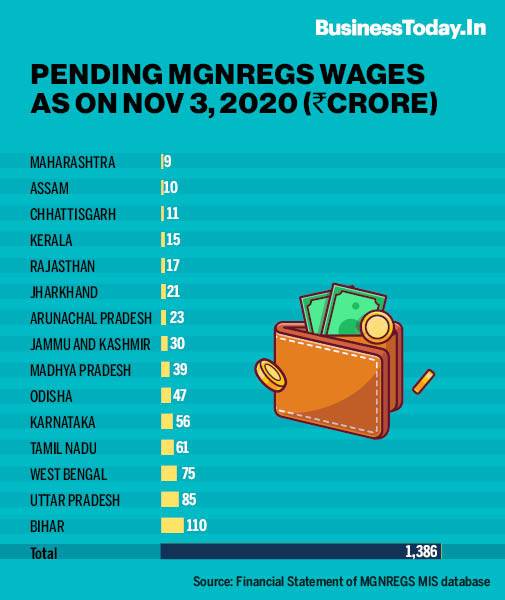
The poor overall financial status also means that wages of millions who have already worked remain unpaid. The official data ("Financial Statement") shows, as on November 3, 2020, Rs 1,386 crore in wages remained unpaid.

This is 65% of the total shortfall in the MGNREGS fund with states.

The lack of funds is particularly distressing given that India is struggling to recover after a massive drop in the first quarter GDP growth (by minus 23.9%). India's growth prospect for the entire fiscal also remains grim (minus 10.3% and minus 9.5% as per the IMF and RBI estimates, respectively).

Also Read: Rebooting Economy 41: India's growing poverty and hunger nobody talks about

Given the fact that much of the economic crisis is on account of the untimely, unthinking and unplanned national lockdown (social and economic) announced on the night of March 24 with a four-hour notice, the central government owes it to the people and states to provide immediate support.

So far, the Centre has released Rs 70,997 crore (as on November 3, 2020), out of Rs 101,500 crore earmarked for FY21 (budget allocation of Rs 61,500 crore and additional relief of Rs 40,000 crore). Out of this, Rs 4,431 crore was meant for the pending dues of FY20.

Unless the central government releases the remaining Rs 26,072 crore (Rs 101,500 minus Rs 4,431 minus Rs 70,997 crore), a large number of states are unlikely to sanction new work or pay pending wages any time soon.

Also Read: Rebooting Economy 40: Why Punjab farmers burn stubble?

9.5 million households, 19 million individuals waiting for work

That the demand for manual work under the scheme has skyrocketed is evident from the number of households and individuals demanding or getting work. Records show that in September-October 2020 the demand for work went up to 48.7 million, from 27.2 million in the corresponding months of FY20, for households and to 55.2 million from 33.7 million for individuals.

The work given under the scheme has also seen a corresponding increase. The months of September-October 2020 saw the number of households getting work go up to 36.3 million from 23 million in the corresponding period of FY20 for households and to 447.4 million from 285 million for individuals.

Simultaneously, the unmet demand has shot up too.

As on November 3, 2020, a total of 9.5 million households and 19 million individuals were waiting for work. In percentage terms, these numbers work out to be 13% for households and 17% for individuals seeking work.

Also Read: Rebooting Economy 39: Why nobody questions industries polluting Delhi air the most?

The following graph maps the worst performing states where the unmet demand has gone up very high. The cases of Uttar Pradesh, Madhya Pradesh and Odisha are particularly worrying given that these backward states have a large number of poor.

Analysis of the official data extracted at different points of time during the pandemic shows that after an initial high the unmet demand went down in August and September but has risen sharply in November.

The MGNREGS is a demand-driven programme under the Mahatma Gandhi National Rural Employment Guarantee Act of 2005, which gives a statutory guarantee to provide work on demand. If no work is given for 15 days, all those demanding work are entitled to unemployment allowance. This provision remains on paper, unenforced even during the current crisis.

Also Read: Rebooting Economy 38: What makes stock markets and billionaires immune to coronavirus pandemic?

Days of work provided are far lower than at any time in the past

It is also shocking to note that despite the current crisis and high demand for work, the average number of days of work given under the scheme is nowhere close to earlier years.

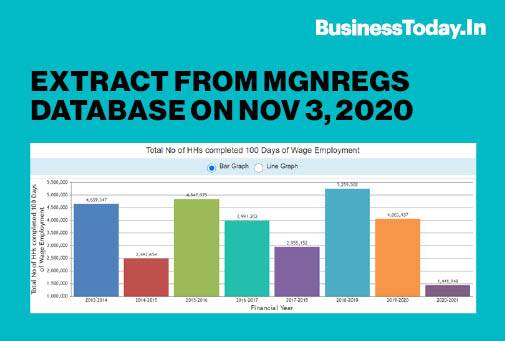
In fact, at 38.81 days, the average days of work per household in FY21 are at the lowest since 2014.

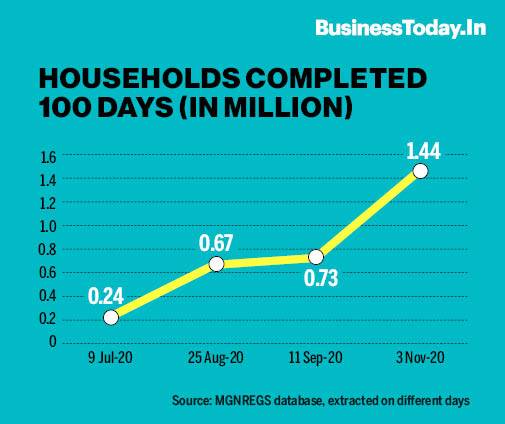
So is the case with households completing 100 days of work.

The good news, however, is that during the pandemic, the number of those completing 100 days of work is going up.

63 million households, 90 million individuals found work under MGNREGS

The significance of the scheme, which provides manual work, would be clear from the number of beneficiaries.

The official data shows, as on November 3, 2020, 63 million households and 90 million individuals have worked under the scheme during the current fiscal year.

Also Read: Rebooting Economy 37: Do high-frequency data suggest V-shaped recovery?

The numbers for earlier years are no less gigantic. In the past few years, households benefiting from it have ranged 51.2-54.8 million and individuals ranged 76.7-78.9 million.

As the above graph shows, the numbers are steadily rising, indicating lack of better paying jobs.

The MGNREGS is a very low-paying work, less than even the minimum wages of states. The central government's rate, after a raise of Rs 20 announced in April 2020 as economic relief for massive job losses, went up from a mere Rs 182 to Rs 202.  

Need to raise MGNREGS allocation several times higher

That the allocations for the scheme need to go up substantially to the current level is not in doubt. It remains a mystery why this did not happen in the past.

Right from the beginning of it in 2005, economists and experts argued for far greater allocation given the rural distress and wide-spread poverty. Rinku Murgai of the World Bank and Martin Ravallion of the Georgetown University had argued then that it should be around 1.7% of the GDP.

Also Read: Rebooting Economy 36: Job creation is nobody's business in India

In their January 2005 paper "Employment Guarantee in Rural India: What Would It Cost and How Much Would It Reduce Poverty?" they reasoned: "At the current statutory wage rate, the scheme may helpreduce rural poverty to 23 per cent(30 per cent year-round), at a cost of1.7 per cent of GDP."

The highest ever fund of Rs 101,500 crore earmarked for FY21 is just 0.7% of the GDP of FY20 (first revised estimate of Rs 145.66 lakh crore at constant price).

The current economic crisis and lack of proper policy or strategy on employment generation make it even more important that the MGNREGS gets the maximum fiscal support from the central government.

Also Read: Rebooting Economy 35: Is fixed term employment a boon or bane for India's workforce?

Rebooting Economy 42: How will changes to land laws in Jammu and Kashmir help, and whom?

 The argument that the new laws are intended to spur investment and boost growth is spurious; more so after special rights and privileges were revoked, the state was downgraded to union territories and its people and political leaders were shut out of democratic space

twitter-logoPrasanna Mohanty | November 2, 2020 | Updated 20:18 IST
Rebooting Economy 42: How will changes to land laws in Jammu and Kashmir help, and whom?
Given the fact that J&K has been at the centre of seven decades of proxy war with Pakistan, it would be wiser to desist from moves that are more likely to aggravate conflicts and endanger national security

With the gazette notification of October 26, 2020 - "Union Territory of Jammu and Kashmir Reorganisation (Adaptation of State Laws) Fifth Order, 2020" - the ministry of home affairs (MHA) has drastically changed land laws in the union territory of J&K, allowing outsiders to own land and automatic change in land use. Apparently, this is to push investment and growth in the embattled region.

It was, however, a unilateral, undemocratic, and sudden move that is more likely to breed mistrust and intensify conflict. Had the central government been honest and serious about its intent to bring prosperity to the region, it would have consulted the stakeholders - mainly the people and political parties of J&K. There was no debate inside or outside the Parliament either.

Also Read: Anyone can now buy land in Jammu and Kashmir, Ladakh; Centre notifies law

It is a grim reminder of the sudden revocation of Article 370 and Article 35A in August 2019 that granted special rights and privileges to the erstwhile princely state of J&K, which had spurned Pakistan and merged with India 73 years ago, and its downgradation into two union territories. Neither had happened before. Every time a state was bifurcated new states were created (Chhattisgarh, Jharkhand, Uttarakhand, and Telangana).  

These moves were followed up by shutting down the entire territory, forcing people into their homes for most part of the day and night, and arresting non-BJP political leaders (some charged under stringent Public Safety Act). When a year later, some of the arrested leaders were released, it did create a flicker of hope for the restoration of democracy only to be dashed by this October 26 notification.

The move raises many questions, not the least because the constitutionality of revoking Article 370 and Article 35A is pending before the Supreme Court (SC), but before that, here is what the October 26 notification changed.

Allowing outsiders to own land in J&K

With one stroke, the gazette notification amends several land-related laws of the erstwhile state and repeals a lot more, the full implication of which will take time to become clearer. What is obvious is that the amendments will allow outsiders to access J&K's land, both agricultural and non-agricultural, which was meant only for permanent residents earlier.

One set of amendments has been made to The J&K Development Act XIX of 1970 to make outsiders eligible for land allocation under "economically weaker sections" and "low-income group" categories by deleting "permanent residents" from the definition of these categories of beneficiaries (Section 2). The same has been done for disposing of government land (acquired for industrial and commercial purposes, but not used) by deleting "permanent residents" from the beneficiaries in Section 17.

Also Read: Rebooting Economy 41: India's growing poverty and hunger nobody talks about

The amendments allow acquisition of land declared "strategic areas" for military purposes and extend the central law governing land acquisitions - The Right to Fair Compensation and Transparency in Land Acquisition, Rehabilitation and Resettlement Act of 2013 - for industrial and other developmental projects.

The amendments also allow automatic change in land use (in Section 11 introduced) once the "master plan" and "zonal plan" are finalised. The need for approval under the J&K Agrarian Reforms Act, 1976 and J&K Land Revenue Act, Samvat 1996, or any other such law for change in land use has been dispensed with.

These amendments will impact land in both urban and rural areas.

Allowing outsiders access to agricultural land in J&K  

Another set of amendments to The J&K Land Revenue Act XII of 1996 throws open agricultural land to outsiders.

Section 133 H, introduced through amendment, bars transfer of agricultural land to "non-agriculturist" except on grounds of sale in decree of courts, mortgage, gift, etc., but provides many exceptions.

It allows land transfer: (i) to agriculturists, inside or outside the territory (ii) to any "category of persons as may be notified by the Government from time to time" as "agriculturist" (iii) to any government, a company or a corporation or a Board "established by or under a statute and owned and controlled by the Government or a Government Company" and (iv) to non-agriculturist "by way of sale, gift, exchange or mortgage or for such agreement on such conditions as may be prescribed" and also for "lease of land or any other arrangement for entering into a farming or production agreement...for...promotion of agriculture and improvement of land".

Also Read: Rebooting Economy 40: Why Punjab farmers burn stubble?

There are many other such provisions: (a) Section 133 I allows agriculture land transfer to public trusts for charitable purpose (b) Section 113 J allows agriculture transfer for promotion of health and education purposes and (c) Section 113 K allows agriculture for industrial, commercial or housing agricultural purpose "or any other public purpose".

Outside of these laws, The J&K Agrarian Reforms Act XVII of 1976 has been amended. Section 28A allows transfer of land ownership only be to "Government or its agencies and instrumentalities". ("Government" in these cases means the central government.) It also says there is no bar on entering into contract farming under the Land Revenue Act, Samvat, 1996 (Act No. XII of Samvat 1996).

Any illusion that these changes in land ownership and use are meant for the development of J&K or bring prosperity to the people of the union territory were dashed by Uttar Pradesh Chief Minister Yogi Adityanath on October 22 when he told an election rally in Patna that, "Earlier, a person from this part of Bihar could not even think of owning property in Kashmir. The Congress had put such a system in place. But Narendra Modi and Amit Shah changed all that. Article 370 has been scrapped and people now have a license to purchase and own property in any part of Kashmir".

This is not something new. Social media and public conversations reverberated with "marry Kashmiri girls" and "buy land in Kashmir" soon after Article 370 was revoked, with a BJP legislator publicly declaring his help in realising such aspirations.

Such frivolity on part of the ruling dispensation is more likely to breed mistrust and endanger national security, rather than bring development and prosperity to the people of the region.

Also Read: Rebooting Economy 39: Why nobody questions industries polluting Delhi air the most?

Many states enjoy special rights and privileges

There is nothing extraordinary about Article 370 or Article 35A.

Contrary to popular belief, special rights and privileges on land ownership exist across India to protect communities, mainly tribals and non-tribals living in forests and hilly areas to prevent their land alienation. No outsider, not even a non-tribal of the same state, is allowed to buy their land.

Article 244 bestows special rights and privileges on the Fifth and Sixth Schedule areas by giving extensive powers to village, district, and regional councils to decide ownership of land, use and transfer of land and collect land revenue. Such rights privileges go beyond land to include all natural resources like forests, forest produce, and minor minerals in their areas.

There are special statutes too. For example, for the Fifth Schedule areas, The Provisions of the Panchayats (Extension to the Scheduled Areas) Act of 1996 (PESA) and the Forest Rights of 2006 give overriding powers to village councils over all other laws of the land. Such areas are spread across the tribal belts of Gujarat, Jharkhand, Chhattisgarh, Himachal Pradesh, Madhya Pradesh, Maharashtra, Odisha, Rajasthan, and Telangana.

Also Read: Rebooting Economy 38: What makes stock markets and billionaires immune to coronavirus pandemic?

While the PESA of 1996 gives a host of rights to tribals to manage their life and natural resources without any administrative and legal interference from outside, the Forest Rights Act of 2006 bars land alienation under any law unless the rights of forest-dwelling communities (both tribals and non-tribals) over their forests and forest land are decided first. No emergency power under any land acquisition law of the Centre or state is applicable in these areas.

Ironically, these laws were brought in response to Left-wing militancy as a part of a two-pronged strategy to fight it: (i) sustained security operations to flush out Maoists and (ii) effective governance and rapid development. Similar strategies have been adopted in the Sixth Schedule area as well.

The Sixth Schedule gives extensive powers to constitute autonomous district and regional councils in Assam, Meghalaya, Tripura, and Mizoram with powers to decide on land, forests, and other natural resources.  

The Constitution also has Article 370 like provisions for some of these states in the northeast region. Article 371A gives all powers relating "ownership and transfer of land and its resources" to the state of Nagaland and no central law is applicable here unless the state legislature decides so.

Also Read: Rebooting Economy 37: Do high-frequency data suggest V-shaped recovery?

Article 371G gives similar power to Mizoram to decide "ownership and transfer of land".

It may come as a shock that no outsider, even if Indian, can even enter Arunachal Pradesh, Nagaland, and Mizoram without written permission from these states. This permission is better known as Inner Line Permit (ILP), which allows entry for a specified period, not beyond that.

The special status granted to the erstwhile state of J&K under Article 370 and Article 35A is no match to all these rights and privileges in the Fifth and Sixth Schedule Areas.

Wonky approach to security

The entire official approach to militancy, which the J&K has witnessed for many years, has been wonky in recent decades; marked by a lack of long-term strategies, clear vision, and consistency in approach.  

Chhattisgarh, under the BJP leader Raman Singh, outsourced the fight against Left-wing extremism to tribals, which led to a civil war, massive internal displacement, and a movement called Salwa Judum (peace march or people's resistance to Maoists). Tribal youths belonging to the Koya community were armed and allowed to fight the Maoists.

Also Read: Rebooting Economy 36: Job creation is nobody's business in India

In 2011, the Supreme Court (SC) strongly indicted the state government for abdicating its constitutional responsibility, violating constitutional principles by outsourcing its job, and disbanded the Koya Commandos.

The approach to the decades' long Naga insurgency is different. The latest chain of events begins with the 1997 ceasefire and subsequent talks with leading rebel Naga group NSCN (I-M). It did not achieve much but peace prevailed. All of a sudden, in 2015 the Centre sprang a surprise, declaring that a Framework Agreement had been signed for "final settlement" but its content was kept secret. It remains secret even now.

A Parliamentary Standing Committee examined the issue and its report was tabled in the Parliament in July 2018. It throws some light on it: "In 2015, the government reached an understanding with the NSCN (I-M), which agreed for a settlement within Indian federation, with a special status...that boundaries of states will not be touched. Instead, some special arrangements would be made for the Nagas where they are."

Also Read: Rebooting Economy 35: Is fixed term employment a boon or bane for India's workforce?

The Parliamentary panel observed that since any final agreement would impact the Naga-inhabited areas of Manipur, Arunachal Pradesh, and Assam "any agreement that may be finally arrived at must allay the fears of the stakeholders in these States and the State Governments must be kept abreast with the emerging dynamics of the talks".

Clearly, that has never been the case. Manipur was the first to erupt in protest when the 2015 Framework Agreement was announced. The central government's obsession with secrecy, so uncharacteristic of a democratic polity, endures.

As negotiations with the Naga rebels began to fall apart in the past few months, the NSCN (I-M) leader and main negotiator of the Naga rebels Thuingaleng Muivah threatened in October 2020 to leave peace negotiations and also leave the country. In a TV interview, he insisted that the Nagas would never become a part of the Indian union nor would they accept India's constitution.

Also Read: Rebooting Economy 34: Temporary jobs hurt both workers and economy

Thuingaleng Muivah is the 'M' of the NSCN (I-M); the 'I', Isak Chisi Swu, died in 2016. Both broke away from the parent National Socialist Council of Nagaland (NSCN) in 1988.

The approach to J&K is very different even though until June 2018, the central government and the BJP had no qualms about running the state as a junior partner of the Mehbooba Mufti-led People's Democratic Party (PDP) for two years.  

Then all of a sudden, the BJP pulled out without a warning, leading to fall of the state government and imposition of the President's Rule. A year later, in August 2019, the MHA dropped the bombshell to deny special rights and privileges to the very same people.  

However, the drastic change in land laws, notified on October 26, 2020, is not applicable to Ladakh, the second union territory carved out of J&K. Given the fact that J&K has been at the centre of seven decades of proxy war with Pakistan, it would be wiser to desist from moves that are more likely to aggravate conflicts and endanger national security.

Also Read: Rebooting Economy 33: Where have the good old full-time decent jobs gone?

Also Read: Rebooting Economy 32: Wage code leaves millions of workers out in cold

Also Read: Rebooting Economy 31: Will new labour codes protect more workers or less?

Also Read: Rebooting Economy XXX: Rural India in far deeper crisis than what govt data claims

Rebooting Economy 41: India's growing poverty and hunger nobody talks about

 Multiple estimates by multilateral institutions show the COVID-19 pandemic will hit India the hardest by sending 40 million people into "extreme poverty", worsen hunger and income inequality, and yet the government seems oblivious with no data, no estimation or policy response

twitter-logoPrasanna Mohanty | November 2, 2020 | Updated 20:16 IST
Rebooting Economy 41: India's growing poverty and hunger nobody talks about
The inept and callous handling of the pandemic and the untimely and unplanned lockdown has jolted India like no other country

Multiple studies have been warning that the pandemic-induced economic crisis would have a cataclysmic impact on the poor globally and be particularly severe in India - home to the maximum number of poor - sending millions back into poverty.

Eight months into the lockdown, estimates are becoming more definitive, though, with a caveat that the situation could worsen if the pandemic becomes more severe as many countries (the US and several European nations) are witnessing a second wave, taking the number of daily virus cases to new heights.

40 million Indians estimated to slip into extreme poverty

Latest estimate from the International Monetary Fund (IMF) reports - World Economic Outlook: A Long and Difficult Ascent, October 2020 and Fiscal Monitor: Policies for the Recovery, October 2020- shows that 90 million people globally would slip into "extreme poverty" (surviving on $1.9 a day) due to the pandemic. This is in line with the World Bank's June 2020 estimate ("Projected poverty impacts of COVID-19") which estimated 70-100 million to slip into extreme poverty.

Also Read: Rebooting Economy VIII: COVID-19 pandemic could push millions of Indians into poverty and hunger

India would account for 40 million of the 90 million the IMF says would turn extremely poor or 44.4% of all. The following graph from the IMF's Fiscal Monitor report shows that in India (extreme left), their number would rise from 80 million in 2018 to 120 million in 2020.

The report explains why (as have many others earlier): "The pandemic has had a disproportionate effect on low-income households in many countries because they areconcentrated in the informal sectors, are more vulnerable to job losses, have lower financial savings, and have less access to healthcare."

The IMF report quotes recent studies in both developed and developing economies to say that the pandemic is impacting the economically more vulnerable, like younger workers and women the most. Those employed in small and medium enterprises or informally employed are more vulnerable to job loss. It also points out that the pandemic would "exacerbate pre-existing trends" in the context of income inequality.

Here is a graph providing a comparative picture of income inequality (measured by Gini coefficient) in both developed and developing economies. India figures next to China entering into the pandemic (second from left in the second chart "Emerging Market and Developing Economies")

India is a basket case when it comes to its workforce: 94% of its workers are informal with little legal protection and social security cover. Here is a graph from former Niti Aayog vice-chairman Arvind Panagariya's latest book "New India: Reclaiming the Lost Glory" 2020 which shows94.2%of its workers are employed in small firms (1-50 workers), 2.3% in medium (51-200 workers) and 5.3% in large firms (more than 200 workers).

In comparison, China's 12.3% of workers are employed with small, 31.1% in medium and 56.6% in large firms. Large firms provide better protections to workers, a privilege enjoyed by very few in India (5.3%). India's recent labour reforms seek to weaken it further by stripping small firms (0-50 workers) completely off whatever legal protections they have had. (To know read "Rebooting Economy 32: Wage code leaves millions of workers out in cold ")

India is more vulnerable to hunger too

Earlier this month, the Global Hunger Index 2020 report ranked India at 94 (of 107 it mapped for the 2020 report), far below neighbouring Sri Lanka, Bangladesh and Pakistan. This index is based on four component indicators: (i) undernourishment (insufficient caloric intake) (ii) child wasting (under 5 years) (iii) child stunting (under 5 years) and (iv) child mortality (under 5 years).

India's progress has been very tardy compared to its neighbours as the following graph shows. Its "child wasting" (low weight for age reflecting acute undernourishment) and "child stunting" (low weight for age reflecting chronic under-nutrition) is particularly poor. The hunger index scores are measured on a scale of 0-100, where '0' represents zero hunger.

The Global Hunger Index 2020 reflects the pre-pandemic situation and comes with a warning: "In 2020, owing to the COVID-19 pandemic, the values of some of the GHI component indicators, and in turn the GHI scores, are likely to worsen, but any changes that occur in 2020 are not yet reflected in the data and scores in this year's report."

As for India, it says: "In India, like in many other countries, the pandemic is aggravating an already serious hunger situation."

That India has been slipping on hunger, poverty and income inequality indicators even before the pandemic hit is well-known. The Niti Aayog report of December 27, 2019 (SDG India - Index and Dashboard 2019-20) showed that of the 28 states and union territories it mapped, 22 saw poverty go up in 2019 compared to 2018 (no change in 4 and improvement in 2); 24 saw hunger go up (fell in 4) and 25 saw income inequality go up (fell in 3) during the same period. (For details read "Budget 2020: Niti Aayog shocker; Poverty, hunger and income inequality up in 22 to 25 States and UTs ")

The following graph maps the Niti Aayog's findings.

Government not bothered about rising poverty or hunger

Ironically, the government never acknowledged the Niti Aayog's report nor took corrective measures. It had done the same for growing unemployment and slowing down of the economy before the pandemic. After the pandemic hit, it never bothered to track job loss or loss of lives of migrant workers, millions of whom walked home for months - a phenomenon not witnessed anywhere else in the world - some perishing on the way.

Consequently, it did not do anything to protect jobs, unlike the OECD countries which saved 50 million jobs, or help survive loss of jobs and livelihoods of millions. In a display of gross callousness, it told the Parliament during the September 2020 session that it has no data and therefore it can't even provide compensation for deaths of migrant workers. (To know how OECD countries saved jobs read "Rebooting Economy XXIII: What stops India from taking care of its crisis-hit workers? ")

The inept and callous handling of the pandemic and the untimely and unplanned lockdown has jolted India like no other country. Its GDP growth for the April-June 2020 quarter tanked to minus 23.9% - the highest among major economies. The RBI estimates the GDP growth for the entire fiscal to be minus 9.5%, as against the IMF's estimate of minus 10.3%, while its global average is estimated to be minus 4%. (To know why read "Rebooting Economy 37: Do high-frequency data suggest V-shaped recovery? ")

With such a poor track record in handling the economy and the pandemic and the consequent human tragedies which go unacknowledged, un-remedied poverty, hunger and income inequality will progressively get worse.

Rebooting Economy 70: The Bombay Plan and the concept of AatmaNirbhar Bharat

  The Bombay Plan, authored by the doyens of industry in 1944 first envisioned state planning, state ownership and control of industries to ...