Wednesday, November 4, 2020

Rebooting Economy 36: Job creation is nobody's business in India

 India has learnt that growth in GDP does not automatically translate into growth in jobs and that GDP growth does not necessarily mean well-being of a vast majority of population. It needs to put these experiences into work and frame appropriate policy responses to the job crisis

twitter-logoPrasanna Mohanty | October 12, 2020 | Updated 18:09 IST
Rebooting Economy 36: Job creation is nobody's business in India
It is time India learnt its lessons and focus on creating jobs to ensure the well-being of vast majority of its population, rather than a selected few

India is probably the only major economy with no accurate data on the size of its workforce or how many lost their jobs to the pandemic-induced lockdown. It did not try to save jobs lost to the lockdown, other than issuing a perfunctory circular on March 29 asking private enterprises to pay wages during the lockdown, which was later withdrawn (on May 17) when challenged in the Supreme Court.

In contrast, the OECD countries saved 50 million jobs through "Job Retention (JR) schemes" by May 2020, as per the OECD's report "Job retention schemes during the COVID-19 lockdown and beyond" released in August 2020. (To know how they did it, read "Rebooting Economy XXIII: What stops India from taking care of its crisis-hit workers? ")

India is also one of the rare countries with no National Employment Policy (NEP) even after years of job-less growth (during the UPA era) and job-loss growth (during the NDA-II era). In the past 15 years (FY06-FY20), the GDP has grown at an annual average of 6.75% (2011-12 base, constant prices).

Also Read: Rebooting Economy 35: Is fixed term employment a boon or bane for India's workforce?

During these years, jobs grew by 3.2% between FY05 and FY12 (annual average of 0.5%) and declined by 1.9% (annual average of minus 0.3%) between FY12 and FY18, according to the Azim Premji University's estimates based on the PLFS data.

What happened to India's National Employment Policy (NEP)?

India is also one of the rare countries with no National Employment Policy (NEP) despite a prolonged job crisis. The PLFS of 2017-18, released in May 2019, had shown that the unemployment rate had touched a 45-year high of 6.1%.

Yet the government did not acknowledge it or frame a policy or fiscal response to it. The unemployment rate did improve to 5.8% during PLFS of 2018-19, but the pandemic has wiped out much more than that gain.

During the job-less era of the UPA, the Union Labour and Employment Ministry started preparing a national policy response. A decade or so later, there is no sign of it.

The 2007-08 financial crisis forced many countries to work on their NEPs. Since then, Pakistan (2010), Nepal (2017) and Sri Lanka (2012) have adopted it. So have a large number of African countries; China did it much earlier (2020). So far, 36 countries have adopted NEPs, 20 countries are in the process and 13 are revising theirs.

Why India failed?

There is no explanation other than official apathy. The labour ministry has been non-responsive. Responsibilities for welfare of different categories of workers are also scattered across ministries of finance, rural development, MSMEs, agriculture, tribal affairs, social justice and empowerment etc. After the national lockdown, the Ministry of Home Affairs (MHA) has become the nodal authority to approve changes in labour laws by state governments, in place of the labour ministry.

Also Read: Rebooting Economy 34: Temporary jobs hurt both workers and economy

Working in a data vacuum

India has very little data on its informal workers, estimated to constitute 94% of its workforce, as per the official records of the labour ministry. The ministry, however, does not disclose the basis of such estimation or the year for which it was done by which agency.

Even in the organised sector, India's datasets are unreliable. For example, the central government told a Parliamentary panel examining the Code on Social Security a few months ago (report was released in July 2020) that about 34.9 million workers had been insured under the ESI Act of 1948 (72 years in operation) while those qualifying for it were estimated at 100 million. The basis of this assertion (100 million) is not known either.

The three labour codes passed in September 2020 provide for registration of different categories of workers (like migrants) and business establishments but without fixing responsibility for any particular authority. These codes talk of registrations "as may be prescribed" by appropriate authority.

Officially, the labour ministry is responsible for maintaining labour statistics, but it hasn't done so in more than 70 years. There is no reason to believe that labour statistics will be available any time soon.

The same goes for wages. No coherent or complete dataset is available with any government agency. In the meanwhile, dramatic changes in wage rates have been noticed which are difficult to decipher.

Also Read: Rebooting Economy 33: Where have the good old full-time decent jobs gone?

Wage trends are not fully understood

On October 6, Xavier Estupinan of the International Labour Organisation (ILO) presented two revealing trends in wages at a training programme of the VV Giri National Labour Institute.

One graph shows 'real' wages in urban areas are declining sharply since FY12 while that of rural wages are rising (though at a slower rate than earlier).

The other graph shows 'real' wages of regular workers are on a sharp decline since FY12, while that of casual workers are going up (although at a slower rate than earlier).

He used the official PLFS and Employment-Unemployment Survey (EUS) data of India to map the trends.

Why such anomalies?

What is better understood is that rural wages have gone up in the past few years for several reasons, including the rural job guarantee scheme MGNREGS, higher MSP, spurt in construction activities and gradual withdrawal of women from the workforce (not necessarily in that order), as the then RBI Governor Raghuram Rajan had explained in 2015.

Why regular wages have stagnated or even fallen is also known. Several studies have shown that growth of contract work and weakened trade unions have worked to the advantage of employers in keeping wages low. (For more read "Rebooting Economy 34: Temporary jobs hurt both workers and economy")

Further, the ILO's 2018 India Wage Report pointed out that workers are being denied their share in the growth of labour productivity. Growing unemployment and job loss (pre-pandemic period) have contributed their share. But what exactly are the reasons for causal wages to go up amidst all these developments? That is not yet understood.

Also Read: Rebooting Economy 32: Wage code leaves millions of workers out in cold

Even what is understood needs to be regularly reassessed given the dynamic nature of labour market and cataclysmic events such as the current crisis. What seemed clear five or 10 years ago may not be true now.

What about jobs for urban workers?

India's response to job crisis has been restricted to the rural job guarantee scheme MGNREGS since 2006 when it was rolled out. Following the lockdown, an additional allocation of Rs 40,000 crore was made for it. What about urban workers? There is no such help for them.

It needs reminding that the MGNREGS was an emergency response to rural distress. By the very design of it (mainly manual earth work), it is Keynesian and is a temporary relief. If it has turned into a permanent job creation mechanism that is because the rural distress has not been addressed through appropriate policies and strategies.

Even this fig leaf is not available to urban workers who too have been facing the job crisis. The pandemic aggravated it further. A study by the London School of Economics, published in September 2020, said: "Unlike many developed and some developing economies, 52 per cent of urban workers (in India) went without work or pay and received no financial assistance to tide over the crisis."

The study used a new field survey of low-wage areas of urban India to show that employment and earnings were decimated by the lockdown resulting from the pandemic.

In response to their distress, development economist Jean Dreze has proposed a scheme of subsidised public employment in urban areas, to be generated by multiple public institutions on their own initiative and is named "Decentralised Urban Employment and Training (DUET)". Dreze was part of the team that conceptualised and drafted the MGNREGS.

Also Read: Rebooting Economy 31: Will new labour codes protect more workers or less?

Dreze's prescription has sparked an interesting debate among economists and other experts who are actively engaged with figuring out the challenges and how to overcome those since the nature of rural and urban works are vastly different. Urban works don't provide a wider canvas and population base that rural works do.

An urban job guarantee scheme may not necessarily be the right answer but there is little to argue against a well thought out national policy to generate employment. All of India's economic policies are focussed on increasing industrial growth (particularly manufacturing) and that of the GDP. Manufacturing has disappointed for decades despite generous help in the form of fiscal incentives, natural resources and much more. High GDP growth has happened without creating jobs, not to talk of well-paid and secure jobs.

High GDP growth has generated even higher inequality in wealth and income. It is time India learnt its lessons and focus on creating jobs to ensure the well-being of vast majority of its population, rather than a selected few.

Also Read: Rebooting Economy XXX: Rural India in far deeper crisis than what govt data claims

Rebooting Economy 35: Is Fixed Term Employment a boon or bane for India's workforce?

 The economic crisis following the pandemic and untimely national lockdown have been used by both the central and state governments to push through unilateral measures that undermine workers' interest by dismantling critical protections

twitter-logoPrasanna Mohanty | October 12, 2020 | Updated 17:45 IST
Rebooting Economy 35: Is Fixed Term Employment a boon or bane for India's workforce?
Though the central Code on Wages 2019 mandates payment of minimum wage, it is not in force in the absence of rules under it

The pandemic induced national lockdown led to massive reverse migration of workers and millions lost their jobs the true extent of which would never be known since the central government did not track it. This should have occasioned better protections for workers; instead, the reverse has happened.

The central government hurriedly passed three new labour codes in September 2020, increasing the thresholds for several legal protections for workers and introducing a new category of employment called Fixed Term Employment (FTE) which can potentially be used to turn permanent workers into temporary (contract) ones.

Before that, about a dozen state governments had issued notifications dismantling many basic protections like payment of minimum wages and minimum working hours, some for a period of the next three years.

Such moves raise serious questions about the true motive of the state apparatus.

Also Read: Rebooting Economy 34: Temporary jobs hurt both workers and economy

Fixed Term Employment (FTE) makes workers more vulnerable

Unbeknownst to many, Fixed Term Employment (FTE) provided in the Industrial Relations (IR) Code 2020 is not a benign move to help contract workers get equal pay, provident fund, gratuity and other social securities at par with permanent employees, as the central government claims. It is much more than just that and will end up harming the workers, as it has already done in Europe.

Here is how.

Firstly, FTE has been included in the Standing Orders (First Schedule of the IR Code 2020) applicable to all industrial establishments, adding a new category of employees to the existing five: permanent, temporary, apprentices, probationers and badlis. It will swell the "temporary" category of workers, though called by a different name.

Secondly, the Central Rules of 1946 under the Industrial Employment (Standing Orders) Act of 1946 provided that "temporary" and "probationers" will become "permanent" after a "period ofthree monthsin the same or another occupation in the industrial establishment".

There is little chance of this being retained in rules to be framed because FTE is now universal in applicability: it is part of the Code on Social Security (SS) 2020; the central government has adopted it for its own hiring and it already exists in the formal private sector for the past two decades.

Thirdly, the gazette notification of March 16, 2018, which introduced the FTE for the first time in the country, had put a restriction on its applicability: "No employer of an industrial establishment shall convert the posts of the permanent workmen existing in his industrial establishment on the date of commencement of the Industrial Employment (Standing Orders) Central (Amendment) Rules, 2018 as fixed term employment thereafter".

This restriction does not find a place in the IR Code 2020 and unlikely to find a place in the rules to be framed. Under the new regime of FTE, a permanent employment can potentially be turned into FTE at any time and fired at will. For those who believe that workers' "consent" matter, there is little choice for them in view of chronic unemployment and massive job loss in recent months.

Also Read: Rebooting Economy 33: Where have the good old full-time decent jobs gone?

A senior leader of the Bharatiya Mazdoor Sangh (BMS), affiliated to the ruling RSS-BJP, says on condition of anonymity that "consent" for Indian workers means "under pressure". He should know because he has been fighting for their cause for decades.

Fourthly, the very concept of FTE comes from Europe which adopted it in the early 2000s. It was meant to provide both flexibility to the industry and act as a stepping stone for young and raw hands to establish their suitability for permanent employment.

But Europe has witnessed a meltdown of a different kind.

Prof. Bas ter Weel of the University of Amsterdam highlighted this in his article "The Rise of Temporary Work in Europe" (published in De Economist on October 22, 2018). While stating that FTE continues to be a stepping stone for young and raw hands, much has changed in five countries he focussed on: the Netherlands, Sweden, France, Spain and Italy.

He listed some significant changes: (i) the transition rate from FTE to permanent employment has been falling over time; (ii) FTE has created duality in labour market with low transition rate and high wage difference (between FTE and permanent workers); (iii) duration of FTE is getting shorter -in Spain, 25% of all new contracts lasts less than a week and 40% last less than a month;(iv)FTE hires are more likely to be low-wage workers, concentrated in the lowest income bracket and (v) FTE is increasing wage volatility and lowering job security.

The European experience should have been a wake-up call for India where 94% of workers are informal with no job security and no social security. The FTEs will cause damage to the rest 6% of formal workers.

A senior BMS leader says FTE is "creating a lawless regime" which should not be in the statute at all. At best, he says, it should be restricted to contract workers in the Occupational Safety, Health and Working Conditions (OSHWC) Code 2020 toensure parity in pay and social security for contract workers with permanent employees. By including it inthe IR Code 2020 (Standing Orders thereunder) as a separate category of workers, it is an invitation to trouble.

Also Read: Rebooting Economy 32: Wage code leaves millions of workers out in cold

Economist Radhicka Kapoor of the Indian Council for Research on International Economic Relations (ICRIER) points out that India first adopted FTE in 2016 in the apparel industry and then extended it to all sectors in the 2018 budget. She welcomes it for providing flexibility to industry (de jure, not de facto), especially in view of the pandemic induced economic crisis, but she also warns against using it to circumvent the hiring of permanent workers.

She argues that a proper framework should be in place to govern FTE which would (i) restrict FTE renewals and facilitate absorption as permanent worker and (ii) restrict it to specific activities outside "core activity" to bring stable employer-employee relationship which is essential for investing in skilling to improve productivity as well as end uncertainty in career and instability in personal life of young recruits.

Given the fact that the traditional contract system exists (hiring through a contractor) and new codes allow employers to hire contract workers directly (definition of employer includes contractor), she wonders if FTE would make any difference to contract employment at all.

As for the flexibility that FTE is supposed to bring, here is an interesting finding.

In 2014, the World Bank carried out a survey of Indian establishments (manufacturing and services) while preparing its "Ease of Doing Business" report (of 2014, published in 2015) to find out how big obstacle labour law "rigidity" in India presented to them.

It found: 35.7% responding firms marked it "minor obstacle"; 17.3% "moderate obstacle" and 10.4% "major obstacle". Clearly, there are far bigger "major obstacles" to ease of doing business in India than its labour laws.

Prof. Kapoor wrote in her policy paper "COVID -19 and the State of India's Labour Market", published in June 2020, thatjust 0.5%of India's total workforce has written contracts of more than 3 years and access to all social security benefits ("a mere 2.2% in regular salaried jobs" out of 24% of total regular wage/salaried category workers). Her estimate is based on the latest data from the PLFS of 2018-19.

It needs no elaboration that employment/wage is the most significant tool for redistribution of wealth and labour laws are critical for both economic and political power to the disadvantaged.

States dismantling even basic workers' rights and protections

State governments are not far behind in undermining the rights and protections of workers. Using the pandemic and the economic crisis, about a dozen state governments suspended them.

The governments of Gujarat, Uttar Pradesh, Madhya Pradesh, Haryana, Uttarakhand, Himachal Pradesh, Assam, Goa, and Rajasthan had done so by May 12, 2020, Maharashtra and Karnataka joined later. Their notifications suspended applicability ofbasic and fundamental legal rights such as payment of minimum wages, minimum working hours and overtime for extra work, not to mention health and safety as well as social security protections (by suspending applicability or increasing thresholds for applicability).

The Uttar Pradesh government suspended, on May 6, 2020, all labour laws for three years except Bonded Labour System (Abolition) Act, 1976; Workmen Compensation Act, 1923; Building and Other Construction Workers Act, 1996 and those relating to women and children.

It later withdrew extending working hours to 12 hours a day (from 8-hour a day), following the Allahabad High Court's notice, but other suspensions, including that of minimum wage, are in force. A petition challenging the suspension of minimum wage is pending before the High Court.

Also Read: Rebooting Economy 31: Will new labour codes protect more workers or less?

Though the central Code on Wages 2019 mandates payment of minimum wage, it is not in force in the absence of rules under it. The Union Labour and Employment Ministry says rules for all four labour codes are likely to be notified together by the end of December 2020. This would mean the Uttar Pradesh workers would be deprived of minimum wages until then.

Limited applicability of SC order in favour of workers

The Supreme Court (SC) received a rare applause on October 1, 2020, when it quashed two Gujarat government notifications exempting all factories from complying with working conditions and overtime payment. These notifications invoked the pandemic to use emergency power granted under the Factories Act of 1948 and extended the working hours to 12 hours with no entitlement to overtime payment.

The top court dismissed the plea that the pandemic threatened India's security in a manner that constituted "public emergency" within the meaning of Section 5 of the Factories Act of 1948 to justify invoking it.

The SC invoked Article 21 (right to life, liberty and equal protection of law) to argue that the "right to life" guaranteed to every citizen under the Constitution includes workers and that denial of humane working conditions and overtime wages provided by law "are an affront to the workers' right to life and right against forced labour that are secured by Article 21 and 23 of the Constitution". (Article 23 prohibits forced labour.)

This law will hold in case of similar modifications under Section 5 of the Factories Act of 1948 in other states but not otherwise.

Some states have changed a host of other laws relating to workers. Uttar Pradesh has issued a series of notifications changing the laws relating to shops and establishments, migrant workers, and many others; Madhya Pradesh changed its Standing Orders of 1961, increasing thresholds from 50 or more workers to 100 or more workers for its applicability.

Also Read: Rebooting Economy XXX: Rural India in far deeper crisis than what govt data claims

All these changes require the central government's approval, labour being a concurrent subject. Ironically, the union labour ministry has no information since no approval was sought from it, says its official spokesman. Instead, these approvals went to the Ministry of Home Affairs (MHA).

While the spokesman couldn't explain why this change, it may have to do with the fact that the MHA invoked the Disaster Management Act of 2005 in March 2020 to micromanage the pandemic, the lockdowns and the unlocking process. The changes in labour laws by the state governments are also premised on the pandemic and its impact.

That the MHA has no domain expertise on labour issues is quite another matter.


Rebooting Economy 34: Temporary jobs hurt both workers and economy


Rebooting Economy 34: Temporary jobs hurt both workers and economy

Part II of this two-part article looks at more data on the growth of temporary or informal workers in India and how it poses a serious threat not just to the wellbeing of millions of its workers but to the growth prospects of the economy in the long run

twitter-logoPrasanna Mohanty | October 7, 2020 | Updated 11:44 IST
Rebooting Economy 34: Temporary jobs hurt both workers and economy
While the labour law rigidity is not in dispute, the growth in contract jobssolely arisingout of it is highly disputed and more often dismissed as insignificant

The central government's big push to replace permanent and secured jobs with casual and contract jobs (temporary or informal) needs to be viewed with concern because while it facilitates maximisation of private profit, it also harms the wellbeing of millions of workers and poses a serious threat to productivity, skilling, economic growth and prosperity of India in the long run.

First, the good news.

Formal employment is growing but not significantly

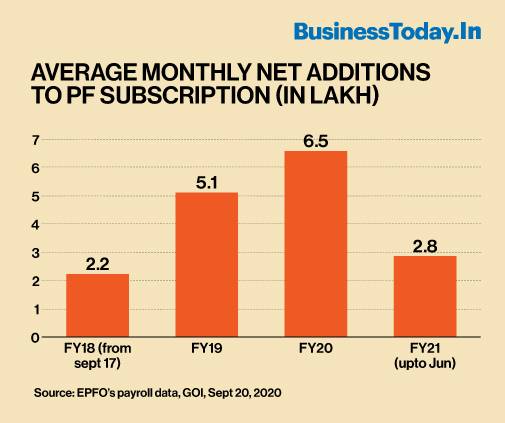
The Employees' Provident Fund Organisation (EPFO) has been spreading cheers by reporting a rapid growth in PF subscriptions, an indication of formalisation of jobs and creation of new jobs in the economy.

Also Read: Rebooting Economy 33: Where have the good old full-time decent jobs gone?

The net monthly additions to PF subscriptions since September 2018, when it began such reporting, have been worked out from its latest update released on September 20, 2020. The decline seen in FY21 is because of the lockdown propelled job losses.

A caveat, however, is in order.

Though Fixed Term Employment (FTE) was introduced in the Code on Social Security 2020 recently, the practice of short-term contract is an old one (two decades or more). Many such contracts do provide for PF subscriptions (not all) but only for the limited period of contract - up to a maximum of three years. It does not cover the entire working life of a worker (30 to 40 years or more).  

There is no restriction on renewal of such a contract, but there is no legal provision to convert it into a permanent contract either. In practice, a short-fixed term contract is a permanently temporary job with no job guarantee even within the contract period. A contract worker can be fired at any time without fuss.

Further, the rise in PF subscriptions should be looked at from the perspective of the total workforce.

Prof. Ravi Srivastava of the Institute of Human Development (IHD) used the past four Periodic Labour Force Surveys' (PLFS) data and adjusted it with population projections for the respective years to work out how many workers in India are formal and how many are informal (in the entire economy) on the basis of written contracts. He treated those with written contracts as formal workers.

Here is what he found.

As the graph shows, workers with written contracts make up less than 8% of the total workforce. Those with any social security (one or more of PF, gratuity, healthcare, pension etc.) are just about 10% of the total workforce.

So, any addition to PF subscriptions is small when you look at the total workforce.

"Informal" workers in formal sectors have grown

Prof. Srivastava also mapped the share of informal workers in the formal sector, both in government and private, using the same PLFS data and using written contracts to determine formal workers. The findings are presented below.

As is clear, the share of informal workers has been growing in both formal government (public) sector and formal private sector. They have an overwhelming presence - 57% in public and 77% in private formal sectors in 2018-19.

The PLFS of 2018-19 saw a reversal in trend with a dip in the share of informal workers in formal private sector. This corroborates the rise in PF subscriptions.

Contract jobs hurt workers

For decades, India's "rigid" employment protection laws have been blamed for stunted growth of industries and employment in India. Popularised through the phrase "the missing middle", it is emphasised that India has a large number of tiny firms and a few very large ones but the middle-level ones are missing, depriving Indians from the benefits of industrialisation and job growth. Recent labour reforms are expected to clear the path.

While the labour law rigidity is not in dispute, the growth in contract jobs solely arising out of it is highly disputed and more often dismissed as insignificant. Academic studies show these rigidities "exist more on paper than in practice".

Also Read: Rebooting Economy 32: Wage code leaves millions of workers out in cold

A study on contract workers in manufacturing units, published in the journal Oxford Development Studies in June 2019, says, among other things: (i) "immediate cost advantages" tilt firms towards hiring contract labour and the labour law rigidity is "insignificant" in explaining the use of contract labour and (ii) there is no significant link between the proportion of unskilled workers and the probability of hiring contract labour (contract hiring is agnostic of skill levels in a firm).

It then goes on to add that "the effect of protective labour legislation on flexibility in the labour market (rigidity) is diminishing".

Another study of 2019 by the Delhi-based think tank ICRIER found the "rigidity" a mere excuse for something else.

It found: (i) contract work has grown in states which made their labour laws more flexible and "amenable to employers" (ii) contrary to expectations "it is the capital-intensive and not labour-intensive industries" which use contract workers more and (iii) "firms appear to be using contract workers to their strategic advantage against unionized directly hired workers to keep their bargaining power and wage demand in check".

The lead author of the study Prof. Radhicka Kapoor wrote elsewhere that it was no surprise that the real wages of directly hired workers has remained "almost stagnant over the last 15 years". Her study found the real wages of directly hired workers one-and-half times more than contract workers over the past decade.

Both studies point to lower labour costs and profit maximisation for hiring workers on contract.

There is more evidence of this.

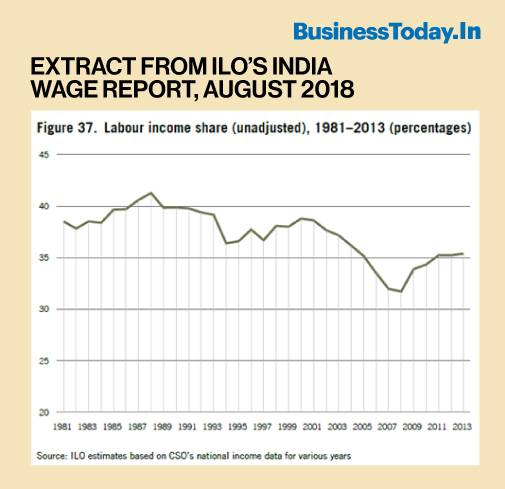
The ILO's 2018 India Wage Report says India experienced a decline in the share of labour income (wage) relative to labour productivity in the post-liberalised era. The average labour productivity increased more rapidly than real average wages - from 38.5% in 1981 to 35.4% in 2013.

This demonstrates that the gains in labour productivity went to employers.

The ILO report blamed "increasing flexibility in the labour market" for this decline in wage, adding: "Looking at the factors that affect wage share within an industry, it is argued that increasing flexibility in the labour market is the key factor contributing to this decline in wage share."

It pointed out that this flexibility has been achieved through "substitution of permanent employees with contract workers, increasing working hours, substitution of women for men as permanent workers, substitution of capital for labour, and substitution of technology for less skilled labour."

Also Read: Rebooting Economy 31: Will new labour codes protect more workers or less?

It warned that with the global rise in capital mobility and falling cost of capital, labour would be "further vulnerable and amenable to flexibility, control and discipline".

While limited in protecting workers' interest, India's new labour laws do not even provide for "equal pay for equal work" between temporary and permanent workers as mandated by the Supreme Court's 2016 judgement in the case of State of Punjab vs Jagjit Singh and others.

The Code on Social Security 2020 provides for equal pay between a Fixed Term Employee (FTE)-contract or temporary worker-and permanent employee of a firm, but not between FTEs themselves, who can be hired at different wages for the same or similar work. This is a normal practice in the private sector and depends on the bargaining power of individual workers.

There is no such protection for a vast majority of contract workers without a written contract. The PLFS of 2018-19 says 69.5% of regular wages/salaried in the non-farm sector have no written contract.

The Code on Wages 2019 removes pay discrimination between men and women but is silent on pay discrimination against ethnic minorities and lower castes. The ILO's 2018 India Wage Report found such pay discriminations (against women, ethnic minorities and lower caste groups) "a significant source of wage inequality" in India.

Contract jobs hurt economy too

Nobody argues that increase in contract jobs helps productivity or economic growth. It only helps private businesses cut labour costs, get away with little protection for workers and maximise profits.

The ILO's 2018 India Wage Report shows that temporary jobs bring low pay and wage inequalities and says these "remain aserious challengeto India'spath to achieving decent working conditions and inclusive growth".

Also Read: Rebooting Economy XXX: Rural India in far deeper crisis than what govt data claims

The 2019 ICRIER study cited earlier studied labour productivity in organised manufacturing sector and found it was significantly higher for directly hired workers than those on contract, both in capital and labour intensive industries. Yet, it said, firms were hiring contract workers.

It also concluded that since contract workers can be easily shed and they work under "deplorable conditions" with little or no job security and fewer benefits in terms of health, safety, welfare and social security compared to directly hired workers, the "sustainability of employment growth driven by growth of contract workers is questionable".

Lower productivity would have long-term consequences for the economy. Besides, employers have no incentive to skill contract workers even if work is of "perennial" nature for which contract workers are banned under the Contract Labour (Regulation and Abolition) Act of 1970 but permitted under the new labour codes, which also permit contract jobs even in "core activities" in certain circumstances. (For more read "Rebooting Economy 31: Will new labour codes protect more workers or less? ")

How do companies which require skilled labour to sustain high production and productivity levels manage to hire them on contract?

Here is an insight from the ILO 2016 report Labour Practices in India. It said: "For this purpose, most companies seem to have come toinformal agreements with contractors not to shift workers without their permission. In this manner the companies are able to secure the benefits of havinglow-wage but skilled workers."

Why India promotes temporary work even in government sector?

This is not difficult to explain.

Ever since India adopted the Fiscal Responsibility and Budget Management (FRBM) Act of 2003 to "ensure inter-generational equity in fiscal management and long-term macro-economic stability" fiscal austerity became the order of the day.

Also Read: Economy XXIX: Exposing farmers to unregulated market is more likely to harm them

This law limits India's fiscal deficit at 3% of the GDP and general government (Central plus state governments) debt at 60% of the GDP (for central government it is 40%). This is in keeping with the mandate of the International Monetary Fund (IMF), which had bailed out India from its foreign exchange crisis, which led to the 1991 economic liberalisation.

These limits are, however, allowed to be relaxed in certain conditions, like the current crisis.

Since India's fiscal deficits have exceeded the limit for several years, the central government is severely constrained when it comes to fiscal spending, which is also reflected in its tight-fist when liberal spending is called for to kick-start the economy. In this endeavour, "revenue expenditure" (called "non-plan" expenditures until 2016 but this classification became irrelevant once the five-year plans and the Planning Commission were dismantled in August 2014) is the obvious target.

Few would argue against cutting down revenue expenditure, as against "capital expenditure" because the latter is considered a far more powerful driver of economic growth. Revenue expenditure mostly involves spending on wages/salaries, pensions etc. Hence, by keeping posts vacant and hiring workers on casual and contract basis helps.

Also Read: Rebooting Economy XXVIII: Is India poised for agriculture-led economic turnaround?

Another development helped the central government in promoting contract workers in its domain.

In 2001, the Supreme Court "over-ruled" its earlier judgement of 1996 that had made it a statutory obligation for an employer to absorb a contractor worker where the contract system was abolished by the Contract Labour (Regulation and Abolition) Act, 1970.

It said an employer can't be asked to absorb contract workers on a permanent basis, although it provided that they be considered first when an employer hires permanent employees and given preferential treatment.

Also Read: Rebooting Economy XXVII: Fiscal mismanagement threatens India's economic recovery

With that protection gone, there is no compulsion for anyone to turn a contract into a permanent job.

The question, however, remains: Should the government jeopardise the wellbeing of its 400-500 million workforce, their families and ignore the long-term damage that contract work can inflict on the economic growth for short-term private gains?

Also Read:Rebooting Economy XXVIII: Is India poised for agriculture-led economic turnaround?

Also Read: Rebooting Economy XXVI: Derailment of economy is not 'Act of God', it is 'Art of Misdirection'

Also Read: Rebooting Economy XXV: How a series of economic misadventures derailed India's growth story

Rebooting Economy 70: The Bombay Plan and the concept of AatmaNirbhar Bharat

  The Bombay Plan, authored by the doyens of industry in 1944 first envisioned state planning, state ownership and control of industries to ...