Saturday, August 1, 2020

Rebooting Economy XII: Is private sector inherently more efficient than public sector?

Global studies show ownership does not make enterprises efficient, factors like competition, autonomy, regulation and institutional development do. Evidence also shows that private sector thrives on public hand-outs in normal times and public bail-outs in crises

twitter-logoPrasanna Mohanty | August 1, 2020 | Updated 11:30 IST
Rebooting Economy XII: Is private sector inherently more efficient than public sector?
Private sector efficiency is a neoliberal economic construct pushed in 1970s by the Chicago school of economics to promote private enterprises and limit the role of state in running economies
Since 1970s it has been repeatedly said that the private sector is inherently efficient and hence the global emphasis on its growth, more often than not, at the cost of public sector. What evidence exists in academic studies and economic history to substantiate this?
Here we look at some of this evidence.
No ownership model is intrinsically more efficient 
In 2015, the United Nations Development Programme (UNDP) published a paper "Is the Private Sector more efficient? A cautionary tale" analysing all existing global studies on comparative efficiencies of public and private sectors with a view to assist in "achieving the UN Sustainable Development Goals (SDGs)" rolled out 2015 for the next 15 years.
It captured the substance and nature of the debate in its entirety, better than any known study. Its two important conclusions were: (i) "no model of ownership" - public, private or mixed - "is intrinsically more efficient" than the other and (ii) efficiency under all ownership models "depends on competition, regulation, autonomy and wider issues of institutional development". 
The third conclusion (the middle one in the box) was that the literature on comparisons lacks academic rigour, sector-specific, and often inconclusive.
It explained this conclusion: "Most literature comparing ownership models looks at specific service sector: health, education, water, sanitation, and so on. The literature that compares public and private provision, in general, tends to be made up of opinion pieces and lacks rigour in comparison to academic and policy studies. The rigorous literature that does exist suggests that efficiency depends on factors such as country context, the sector, the market the firm operates in and the firm's organisation, rather than ownership." 
This is primarily because private sector efficiency is a neoliberal economic construct pushed in 1970s (first) by the Chicago school of economics to promote private sector and limit the role of states (government) in running economies. In 1980s this was pushed and imposed on non-Anglo-Saxon countries by the World Bank and International Monetary Fund (IMF) when these countries sought loans to tide over their economic crisis. (For more read 'Deconstructing Neoliberalism II: How neoliberal ideas can wreak havoc on economies ')
Two major elements of this push were (a) handing over ownership of public-owned enterprises to private entrepreneurs and (b) public-private partnerships (PPP).
Hence, all comparative efficiency studies focus on these two developments.
Efficiency Test 1: Ownership change designed to undermine public enterprises
Stiglitz et al published a cross-study in 2011 comparing how change in ownership from public to private changed their performance, "Ownership change, institutional development, and performance". It found no conclusive proof of private sector superiority.
It pointed out that "a basic insight is that institutional quality matters more than ownership". It held that profitability (measure of efficiency) post-ownership change was "most directly tied" to protection of private investors against expropriation and better enforcement of contractual rights". It also highlighted that more likely, such ownership change happened in case of public enterprises "that perform well, biasing traditional tests of performance effects of privatisation".
Stiglitz wrote elsewhere that the theoretical case for such change "at best, is weak or non-existent". In the foreword to a book on neoliberalism, he wrote how a few individuals grabbed "previously state-owned resources for a pittance and become millionaires - or billionaires".
He added, "Russia became a country (after the fall of communism towards the end of 1980s) marked by great inequality, with a Gini co-efficient as bad as many in Latin America" and that "by some estimates, $1.5 trillion in assets were stolen" in Russia.
The Guardian carried an interesting report in 2013 that marked 20 years of ownership change in the UK rail, "'The private sector is superior'. Time to move on from this old dogma". It cited the rail regulator's report to say that "the single remaining state-run mainline rail service (East Coat rail services), required less public subsidy than any of the 15 privately run rail franchises in Britain".
The ownership change happened in 1993 with the promise of eliminating subsidies, increasing efficiency and reducing fares (through competition). The UK's parliamentary reports show the subsidies stood at 2.74 billion pounds at the time of change (1993-94), went up to 7.48 billion pounds in 2006-07, and touched 7.1 billion pounds in 2018-19. The UK has some of the most expensive rail tickets in Europe.
The 2013 Guardian report had further pointed out that "some of the UK's largest private care home providers effectively bankrupted themselves and had to be saved by public intervention". (This is a subject of wider study by economists drawing attention to the pitfalls of takeover and financialisation of care homes by private equity (PE) firms).
Similarly, it said the banking system "is only standing today due to monumental public backing" and that "private finance is much more expensive than direct public investment: the cost of capital under the heavily used private finance initiative was estimated by the Financial Times in 2011 to have added 20 billion pounds to the taxpayers' bill".
There are other high public costs to private businesses.
In the case of India, ownership changes have happened with free handover of huge public assets of public sector undertakings (PSUs) to private enterprises; defunding of PSUs for many years (state-owned telecom companies, publicly-run schools and hospitals etc.) to vacate space for private enterprises (telecom, hospitals, and schools) and debt waivers (Rs 29,474 crore of Air India's debt was shifted out in 2019 and more is on the anvil to "sweeten the deal" for private take over).
Such incidences make comparisons between public and private sector efficiencies futile.
In 2006 audit report the Comptroller and Auditor General of India (CAG) had pointed out several such incidences: (i) core assets of Modern Bread, like leasehold land and plant and machinery, were not valued before the change of ownership (ii) leasehold land housing the plant and fully developed township of BALCO were not valued (iii) non-core assets were not identified and properly valued for BALCO and India Petrochemicals (IPCL) (iv) real estate, land and building of VSNL and Paradeep Phosphates were "either discounted or not considered" in absence of clear title for which the administrative ministries made no effort (v) only one of three operational mines of Hindustan Zinc (HZL) was valued (vi)  "far too conservative assumptions" were made in valuation of 7 out of 9 PSUs under the discounted cash flow methodology without recording reasons for such assumptions etc.
The Russia, UK and India examples lead to questions that beg for answers: Is private enterprise really private or inherently carry substantial public money and natural resources? How does one compare efficiencies when the ownership change is structurally designed to benefit private enterprises?
Efficiency Test 2: PPPs designed to benefit private enterprises
A 2004 IMF paper examined the impact of public-private partnerships (PPP) in providing infrastructure assets and services.
Talking about PPPs taking off in many countries across the world, it concluded: "However, it cannot be taken for granted that PPPs are more efficient than public investment and government supply of services. One particular concern is that PPPs can be used mainly to bypass spending controls, and to move public investment off budget and debt off the government balance sheet, while the government still bears most of the risk involved and faces potentially large fiscal costs."
In India, the PPP model has already failed and abandoned during the later years of the UPA era. In the case of National Highway Authority's projects, which used PPPs extensively, it was revealed through "internal paper" of the erstwhile Planning Commission and RTI reply that financial institutions, mostly the public sector ones, had given loans nearly twice the total project costs (TPCs) in the case of just 20 projects.
While the TPCs were Rs 13,646 crore, banks lent Rs 25,940 crore without collaterals or guarantees to private partners. This meant half the money was not even meant for these projects and must have been diverted by private partners. Besides, the NHAI gave 40% viability gap funding (VGF) upfront.
Taken together, this would mean for a project cost of Rs 100 crore, the private partner is walking away with Rs 230 crore (Rs 90 crore of additional loan without collateral and Rs 40 crore of VGF). Later, the private partners did not even pay that. The NHAI's road projects contributed significantly to the rise in NPAs subsequently.
The NHAI PPPs even allowed private partners to walk away at any time, which some did, and allowed toll collections far in excess of the agreed amount through gross understatement of vehicular traffic projections, until in the case of some, like the Gurgaon Expressway flyover, they were caught and toll booths dismantled.
What would be the score of efficiency of these private partners?
Now, in the midst of the health crisis caused by the COVID-19 pandemic, the government has revived the very same PPP model in healthcare even while the private healthcare has spectacularly failed to respond to the crisis in India and the US.
In May 2020, the government think tank Niti Aayog wrote to the chief secretaries of states asking them to set up medical colleges in PPP mode, provide 40% VGF plus handover government-run district hospitals to private partners. (For more read 'Rebooting Economy X: COVID-19 puts question mark on private sector's efficiency in healthcare ' and 'Coronavirus Lockdown XI: Why India's health policy needs a course correction ')
There is more to the inefficiencies of private healthcare.
In India, there is a flood of complaints about private healthcare facilities: black marketing beds, giving false COVID-19 test results for money, refusal to treat and overcharging costs, apparent failure of some state governments to rein them in.
More than four months after the Disaster Management Act of 2005 was invoked to give sweeping powers to requisition such services and COVID-19 cases have gone up sharply (total cases crossed 1.5 million in India on July 29) the Karnataka government is still negotiating with private healthcare for beds and charges.
What would be the efficiency score of private healthcare in India?
Efficiency Test 3: Damage to human rights, further marginalisation of workers
A UN report tabled in the General Assembly in September 2018 looked at the impact of change in ownership from public to private.
Its finding said such ownership change "often involves the systematic elimination of human rights protections and further marginalisation of the interests of low-income earners and those living in poverty" and as some "aspects of criminal justice system are privatised, many different charges and penalties are levied with far greater impact on the poor, who then must borrow to pay them or face default".
It further said the neoliberal shift to private ownership had changed the very definition of personal freedom: "Freedom is thereby redefined as an emaciated public sector alongside a private sector dedicated to profiting from running key parts of the criminal justice system and prisons, determining educational priorities and approaches, deciding who will receive health interventions and social protection, and choosing what infrastructure will be built, where and for whom."
Yes, private contractors run prisons in the US. Powerful private corporates "force their customers to forego the use of our public legal system for the adjudication of disputes... and instead use secretive arbitration panels that are stacked in favor of the companies" as Stiglitz wrote in his 2019 book "People, Power and Profits".
In the same book, Stiglitz also wrote how under the legendary Steve Jobs Apple got together with Google, Intel, and Adobe secretly to agree not to "poach" each others' employees ("anti-competition conspiracy"), which was exposed, and led to a lawsuit which was settled for $415 million.
He also mentioned that Disney and a host of film studios similarly paid a huge settlement for illegal anti-poaching conspiracy and that fast-food franchise agreements have such provisions. Such practices undermine both competition and wages.
Efficiency Test 4: Push for private enterprises at the cost of public ones
Why country after country undermines the public sector and follows the neoliberal construct of private sector efficiency when no evidence and no economic theory validate it and let the impression gain that the public sector is inherently corrupt, incompetent, and inefficient?
The UNDP report of 2015 mentioned earlier listed 7 reasons: (i) political support to undermining public sector benefits (ii) neoliberal push (Public Choice theory) that the public service is inherently self-serving and need to be checked (iii) commercial gains (profits) for consultants and businesses (iv) politicians' need for deflecting criticism of their own failures (v) relatively lower pay for professional posts in public sector (vi) obstructive public sector labour unions and unhelpful bureaucrats and (vii) "both elected leaders and senior administrators benefit from creating a 'permanent revolution' of ceaseless reforms and reorganisation of the public service... the temptation to appear to be shaking up supposedly lazy and incompetent bureaucrats is all too great".
Public Choice theory of neoliberal economist James McGill Buchanan successfully attacked state and public institutions theorising that government failure is the rule and it happens because private interests "capturing" policymakers through nepotism, cronyism, corruption or rent-seeking, misallocation of resources and crowding out private investment, etc.
He or anyone else never explained how by handing over everything to the very same private sector that caused all of these ills would remedy and not worsen these problems. (For more read 'Deconstructing Neoliberalism I: What is Crab-walk strategy; is it relevant for India in present times? )
Efficiency Test 5: Multiple market failures
Market failure, rather private sector failure (market is defined as all private sector structures that facilitate exchange of goods and services), is the biggest problem but receives the least attention from economists and policymakers.
In fact, history is replete with such evidence.
The 1929 Great Depression and 2007-08 Great Recession were caused by the private financial sector companies through their misadventures. There are a series of regional or country-specific economic crises caused by the financial misconducts of private financial companies and/or the neoliberal push for capital and financial market liberalisation without putting effective regulatory mechanisms in place by the World Bank-IMF: dot.com burst (2000-01), Asian financial crisis (late 1990s), Latin American crisis (1990s-2000s), Japan crisis (1990s-2000s) and many others.
Economic crises would persist because in spite of the severe consequences of 1929 and 2007-08, that led to millions of people losing jobs and incomes and the collapse of many big private companies, the neoliberal economists continue to insist that "recession" is cyclical, inevitable and most importantly, "a good thing, part of the economy's adjustment to change" and that fiscal austerity is required to fight recession, as economist Paul Krugman wrote about their bizarre economic constructs.
Neoliberal economists also insist unemployment is good because it is voluntary (not for lack of jobs) and workers like to take breaks from backbreaking labour to relax; workers' wages should be low because higher wages lead to high cost of production and loss of employment; cutting tax for the rich benefits the non-rich (trickle-down effect) etc. (For more read 'Deconstructing Neoliberalism IV: How neoliberals won the world but India can ill afford their economics ')
There is yet another element to the debate of efficiency in the public and private sector.
It is no secret that the private sector thrives on public hand-outs in normal times (tax holidays, concessions and outright corporate tax cuts; cheap land, mines, forests and other natural resources' infrastructure and human capital built with public money etc.) and public bail-outs during crises (stimulus packages, grants, and loans). (For more read 'Rebooting Economy IX: Why is private sector dependent on public money in times of crisis? ')
That is why the maxims "privatisation of rewards and socialisation of risks" and "privatisation of profit and socialisation of loss" ring true.
At the end of it all, where does private sector efficiency stand?

Rebooting Economy XI: Why are private companies so prone to financial frauds?

Apart from rise in financial frauds in private companies in India, recent years have also witnessed a rise in the role of shell companies and tax havens in their operations, raising further concerns about illicit operations

twitter-logoPrasanna Mohanty | July 29, 2020 | Updated 20:31 IST
Rebooting Economy XI: Why are private companies so prone to financial frauds?
Wilful default is quite common to Indian private enterprises. A large part of borrowings is then written off with public money
On July 22 while India was recording new highs - in COVID-19 case and death counts and in the height of the Ayodhya's latest Ram temple from 161 ft in its 1988 design to 181 ft - a new watchdog of corporate governance made its debut.
On that day, the National Financial Reporting Authority (NFRA), regulator of auditing, announced debarring former Deloitte India CEO Udayan Sen for seven years and imposed a penalty of Rs 25 lakh for "professional misconduct" as Engagement Partner (EP) in auditing and certifying financial statements of the scam-hit IL&FS Financial Services (IFIN) for 2017-18.
The NFRA order said Sen went by the company's attempt at "fraudulent presentation of financial statements" relating to net-owned funds (NOF) and capital adequacy ratio (capital-to-risk assets ratio or CRAR), adding "the fact that the company had ceased to comply with the stipulated NOF/CRAR norms was deliberately misstated". It found the IFIN had incurred losses in 2017-18 which was "turned into a reported profit".
It concluded: "the statutory auditor (Sen) had been totally compromised".
The IFIN is a subsidiary of the Infrastructure Leasing and Financial Services (IL&FS), a non-banking or shadow banking company which collapsed in 2018 under its own financial misconduct. Banking regulator RBI found it had not disclosed bad loans for four years and initiated bankruptcy proceedings.
The government had sought a five-year ban on the IL&FS's statutory auditors - Deloitte and a KPMG affiliate, two of the Big 4 audit firms, others being PwC and Ernst & Young - for allegedly aiding and abetting the financial fraud.
On April 22, 2020 the Mumbai High Court ruled (though video conferencing) that (a) the Ministry of Corporate Affairs (MCA) and National Company Law Tribunal (NCLT) can't take action against the audit firms of the IL&FS and (b) quashed criminal complaint filed by the Serious Fraud Investigation Office (SFIO), calling it "bad in law" and "non-application of mind".
The court said though the Companies Act of 2013 provided for removing auditors that (Section 140(5)) wouldn't apply to auditors who have resigned.
The new regulator NFRA has filled a legal void. It was set up in 2018 under the Companies Act of 2013 (five years later).
Will it make a material difference to financial frauds by setting the standards? That is highly unlikely.
Here is how.
Secret behind corporate frauds: Built-in conflicts of interest
The Satyam Computers scam was a watershed moment for India that led to the NFRA. It thoroughly exposed what is wrong with auditing.
A private company, the Satyam Computers unravelled in January 2009 when the man responsible for its phenomenal success and eventual overnight collapse, B Ramalinga Raju, wrote to market regulator Securities and Exchange Board of India (SEBI) detailing all its murky financial deals. Even then, the SEBI took 5 years to investigate and pass its orders.
Raju had been an icon of private sector success (IT sector) and the toast of Indians until then.
The SEBI's 2014 order reproduced Raju's confession letter which revealed: (i) "non-existent" bank balance which "resulted in artificial cash and bank balance going up by Rs 588 crore in second quarter of FY09 (ii) "non-existent" accrued interests of Rs 376 crore (iii) "understated liability" of Rs 1,230 crore (iv) "overstated debtors position" of Rs 490 crore etc. Raju said this had been going on for seven years.
Here is a dead giveaway. Any student of chartered accountancy (CA) doing "articleship" would have detected the company's frauds simply by matching its claims on bank balances with actual bank statements.
The following table (taken from the SEBI order) gives the gap between the company's claims and actual bank statements regarding its fixed deposits as on September 30, 2008.
How did a battery of chartered accountants (CAs) from the Big 4 giant PricewaterhouseCoopers (PwC) miss it, assuming that "articleship" students failed the test of due diligence? Was it an oversight?
Here is another example. The company claimed a cash balance (on September 30, 2008) of Rs 1,782.60 crore in the Bank of Baroda's New York office while the bank statement said it was Rs 50.72 crore.
No way such mismatches could have gone undetected for seven consecutive years.
How did it happen then?
The first answer is the structural design of financial reporting. It is a self-certifying exercise. A private company hires and pays an audit firm for certifying its books of accounts - a clear conflict of interest.
"He who pays the piper calls the tune" is an age-old maxim. Instead of changing this rule of the game it has been perpetuated to the advantage of private entities like Satyam Computers. Interestingly, the SEBI asked Raju and his associates to "to disgorge the wrongful gain" of Rs 2,353.46 crore earned through insider trading and/or pledging of shares that the CAs would have detected instantly.
Second, the Big 4 themselves have complex organisational structures aimed at subverting Indian laws and regulatory mechanisms. To expect them to ensure integrity of financial reporting of their clients would be naive.
They were once the Big 5. The fifth, Arthur Andersen, collapsed after its client and the then darling of Wall Street, Enron Corporation, collapsed overnight in 2000 when its financial accounting turned out to be built on fake holdings, fake profits and off-the-book accounting. Enron had set up the Dabhol mega power plant (Maharashtra), now being run by public sector units NTPC and GAIL.
Third, the Big 4 audit firms facilitate financial flows to tax havens through shell companies for tax evasion purposes by shifting revenue and profits of their clients.
Before providing evidence for all of this, here is about the Satyam Computers' auditor.
One of the Big 4, the PricewaterhouseCoopers (PwC) audited its accounts. SEBI banned it for two years in 2018 (9 years later). A few months later, in September 2018, the Securities Appellate Tribunal (SAT) quashed it saying (i) there is no evidence of wrongdoing or collusion on part of the PwC (ii) SEBI has no jurisdiction and (iii) banning an audit firm is the "sole prerogative" of the Institute of Chartered Accountants of India (ICAI).
The ICAI is a statutory body set up in 1949 as the self-regulatory watchdog of CAs but has been ineffective, just like the Press Council of India, the self-regulatory watchdog of journalists.
Secret of financial and auditing frauds in India: Unregulated Big 4
To its credit, the ICAI did seek regulatory authority over the Big 4 during litigations that led to a Supreme Court order in 2018 directing the government to frame an appropriate law.
The case pertains to allegations of multiple transgressions by the Big 4, commonly referred to as Multinational Accounting Firms (MAFs), and their Indian associates. In all, 171 such firms were under scrutiny.
The apex court order said: "...having regard to the statutory framework under the CA Act, current FDI Policy and the RBI Circulars, it may prima facie appear that there is violation of statutory provisions and policy framework effective enforcement of which has to be ensured."
It directed further investigations by the Enforcement Directorate (ED) and framing of appropriate law observing that the "accounting firms could not be left to self-regulate themselves". The charges against them were brought after a series of enquiries by the ICAI and ED's investigation into illegal remittances.
The charges are very serious: (i) violation of the Chartered Accountancy (CA) Act of 1949 that prohibits foreign chartered accountancy firms (companies or partnerships firms) from working in India without reciprocity with the country of their residence (ii) no regulatory control as management and audit firms (MAFs) are not registered with the regulator ICAI (ii) profit-sharing and capital contribution (including for buying Indian CA firms) by violating the FDI policy prohibiting FDI in accounting, auditing, book keeping, taxation and legal services and not seeking RBI's prior approval (iii) entered India for consultancy services but transgressed into taxation, auditing, accounting, book keeping and legal services (multiple conflicts of interest) (iv) not disclosing details of operations and (v) their partnership firms in India are "merely a face to defy the law" that calls for "lifting the corporate veil".
There is no sign of any such law regulating the Big 4 until now.
Preponderance of corporate frauds in private sector
How do private companies fare vis-a-vis public companies in corporate frauds?
The data is difficult to come by but a series of corporate frauds in India in recent months and years reveal that private enterprises dominate (though their victims are more often public sector banks).
The list of high-profile private entrepreneurs turning fugitive is long: Nirav Modi, Mehul Choksi, Vijay Mallya, Jatin Mehta (Winsome Diamonds), Sandesara brothers (Sterling Biotech) and many more. In April 2019, the ED told a special court that 36 businessmen who have criminal cases pending against them fled India in recent years.
Besides, there are plenty of private entrepreneurs in India who are accused of fraud and are facing investigation: Rana Kapoor (Yes Bank), Rakesh Wadhawan and son Sarang Wadhawan (HDIL and DHIL), Chanda Kochhar (ICICI-Videocon scam), just to name a few.
In a joint study published in May 2020, the Universities of Toronto, California and Chicago found that in the US "11.2% of large publicly-traded US firms on average are engaged in corporate fraud". The study did not disclose relative incidents of frauds in public and private sector enterprises, but an idea can be gleaned from another study.
The study was of 2000 by three other US universities: Texas A&M University, Sam Houston State University and University of Texas. They contacted members of the Association of Certified Fraud Examiners to study corporate frauds. Out of a total of 2,471 cases they received, 611 (25%) related to government-run units and 1,860 (75%) private-run.
What about India? There is no study that looked beyond a sample size of 100 fraud cases to rely on.
Tax evasion, shell companies and tax havens
The real attraction of the Big 4 is not the quality of auditing.
A 2012 joint study by the UN Global Compact-TARI-Indian Institute of Corporate Affairs (IICA) found that the presence of Big 4 firms made no difference to the incidents or detections of frauds, thereby ruling out quality issues. It concluded that "number of frauds in our study is equally distributed among firms audited by the Big 4 and Non-Big 4 auditors..."
A series of recent financial scams involving the Big 4 - from the Satyam Computers (PwC) to IFIN (Deloitte and KMPG), National Spot Exchange Limited (NSEL) scam (Ernst & Yung) - makes it clear.
The Big 4 are popular for tax evasions. Their connections with tax havens are well known. Investigations into the Panama Papers and Paradise Papers revealed such murky deals at length. Many Indians figured in the first. Prof. Ronen Palan of University of Birmingham and his co-authors of 2010 book 'Tax Havens: How Globalization Really Works' pointed out that the Big 4 were "the very heart" of the gigantic offshore/tax haven world "without which, all this would be impossible". (For more read 'Taxing the untaxed VII: Who supports tax havens and how do they flourish? ')
A 2018 global, firm-level study found "clear evidence of a strong correlation between tax haven use and the use of Big 4". It was a joint study led by the UK's Aston University which found the Big 4 associated with at least 2.9% higher growth rate of tax haven subsidiaries.
It is a different matter that some of the private enterprises, like the Lehman Brothers, linked to the US sub-prime crisis and whose collapse triggered the global panic leading to the 2007-08 Great Recession, was registered in an internal US tax haven - Delaware.
Tax evasion is quite rampant in private sector.
In December 2019, a UK-based transparency campaign group Fair Tax Mark published an investigative report showing that the top six global private companies, Google, Amazon, Facebook, Apple, Microsoft and Netflix, described as the Silicon Six, avoided paying $100 billion tax between 2010 and 2019.
According to OECD-G20's anti-tax avoidance initiative (BEPS), tax avoidance by private companies amounts to $240 billion every year. A 2019 study by the International Monetary Fund (IMF) said the non-OECD countries were losing 1.3% of their GDP or $200 billion of revenue every year to profit-shifting (to tax havens) and the OECD countries about 1% of GDP or close to $450 billion. (For more read 'Coronavirus Lockdown XII: Why the wealthy should be taxed more')
Shell companies have emerged as the conduit for such illicit financial flows for private companies. In August 2017, the Indian government announced that 300,000 shell companies had been identified for tough action, of which 175,000 had already been struck off with a single stroke.
A few months later, when private sector financial fraud cases stumbled out, namely the PNB (Modi and Choksi), PMC (Wadhawans' HDIL and DHFL), IFIN, Yes Bank (Rana Kapoor) and ICICI-Videocon (Chanda Kochhar) scams, hundreds of shell companies flooded out. The ICICI-Videocon scam revealed a loan was given to a firm in tax haven Cayman Islands. (For more read 'Taxing the untaxed IX: Is India blissfully ignorant to the menace of shell companies? ')
A 2019 IMF-University of Copenhagen study found $15 trillion of the total $40 trillion FDI channelling around the globe is "phantom" FDI structured to avoid corporation tax. The phantom FDI works out to be 37% of the total FDI and equals the combined annual GDP of economic powerhouses China and Germany. Surely, this is not the handiwork of public sector players. (For more 'Taxing the untaxed VI: What are tax havens and why they matter to India ')
Diluting bankruptcy law to save private enterprises
Former RBI Governor Urjit Patel, who had resigned in 2018, recently came out with a book, 'Overdraft: Saving the Indian Save', revealing how the Indian government diluted the Insolvency and Bankruptcy Code (IBC) to help loan defaulters.
His book says after the dilution the time-bound threat of insolvency application isn't credible anymore and that the victory over crony capitalism is at risk. Except for a few public sector enterprises like the Tamil Nadu Generation and Distribution Company, Northern Power Distribution Company, Burn Standard and Company and Hindustan Paper, most of the companies facing bankruptcy proceedings are private ones.
Patel revealed pressures to dilute the bankruptcy application. That it came from private entities is evident. The officiating Finance Minister Piyush Goyal's famous statement of February 2019 that "law cannot be blind, wherein in 90 days arithmetically it becomes a non-performing asset (NPA)" came in his address to a private industries' association.
In its financial stability report released on July 24, 2020, the RBI has warned that the gross NPAs in Scheduled Commercial Banks (SCBs) could rise from 8.5% in March 2020 to 14.7% by March 2021.
On July 27, HDFC Chairman Deepak Parekh asked the RBI governor not to extend moratorium on loan repayments, pleading that borrowers who have the ability to pay are taking advantage and not paying.
Wilful default is quite common to Indian private enterprises. A large part of borrowings is then written off with public money.
In any case, private sector has been thriving on large public hand-outs and public bail-outs. Therefore, dilution in the IBC is not such a good idea. (For more read 'Rebooting Economy IX: Why is private sector dependent on public money in times of crisis? ')
That is not all.
Growth of private sector in India, particularly the spectacular growth of some industries, owes it to "cronyism" during both the licence-permit era of pre-1991 and the liberalised era of post-1991. This is state-capture wherein the state works for private companies.
Then there is regulatory-capture, wherein independent regulators do the bidding of private sector. The coal and telecom (spectrum) scams demonstrated both.
More often than not, state-capture and regulatory-capture come at the cost of public sector growth (telecom, for example).
The coronavirus pandemic-induced economic slowdown has made no dent in such cronyism.
Eminent scholar Noam Chomsky was scathing in his comment, during an interview on July 24, 2020, on how the top private corporate giants in the US are enriching themselves with President Donald Trump's help.
He said, "They're just running wild, using Trump and the administration or using the cover of the pandemic to increase their dedication to enriching the very rich and the corporate sector who are, of course, eating it up. They love it."
For anyone to argue that the private sector is inherently more efficient than the public sector is not just facile but without merit. This is reflected in studies comparing efficiency of the two sectors.

Rebooting Economy X: COVID-19 puts question mark on private sector's efficiency in healthcare

Profit-driven enterprises are ill-suited to protect the health and life of a vast majority of people, as the US and Indian governments experience, but do precious little, thereby failing in their primary duty

twitter-logoPrasanna Mohanty | July 27, 2020 | Updated 21:30 IST
Rebooting Economy X: COVID-19 puts question mark on private sector's efficiency in healthcare
India's private healthcare accounts for 70% of national healthcare needs and yet when the pandemic hit, almost all of private healthcare facilities shut down
The COVID-19 should serve as a wake-up call for all those who advocate private sector's superiority over public sector.
The United States (US) is a good example to begin with.
COVID-19 exposes US's private sector-driven healthcare
Ever since the coronavirus pandemic hit, there has been a flood of reports, studies, and analysis saying why and how the US healthcare system largely driven by private providers (hospitals and health insurance) has failed spectacularly to protect the health and life of its citizens.  
The best argument against its private healthcare system is the continued surge in the number of COVID-19 cases and deaths when other developed countries have contained it. The US has repeatedly breached the 70,000-mark in new cases per day in recent days, and India crossed 49,000 new cases on Monday (July 27).
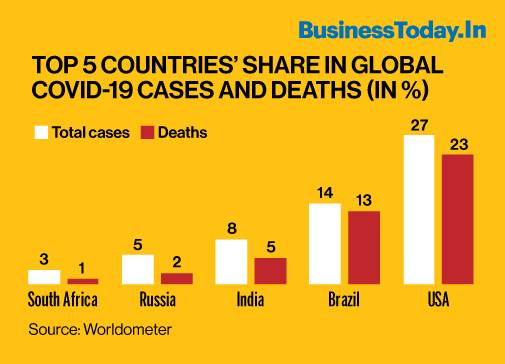
The US maintains its lead in both the number of cases and deaths month after month. As on July 23, the US accounted for 27% of total cases and 23% of total deaths. India is third in rank with a share of 8% and 5%, respectively. The total number of cases in both countries has crossed 4.3 million and 1.4 million as of date, respectively.  
This surge is not entirely due to the inefficiencies of private healthcare for sure. The failure of political leadership is equally to blame but there is no disputing that a better healthcare system would have made a significant difference through access (inclusion) and affordability to quality healthcare.
The Commonwealth Fund's latest study published on January 30, 2020, says that the US spends the most on healthcare - 16.9% of its GDP or $3.5 trillion in 2018, which is nearly twice the OECD average - but is one of the worst when it comes to results.
It says, among the OECD peers, the US has the lowest life expectancy and highest suicide rates; it has among the highest number of hospitalisations from preventable causes and rate of avoidable deaths and its out-pocket spending second highest, next to Switzerland.  
The US-based Brookings Institute's March 10, 2020 paper says the US healthcare is "largely consists of private providers and private insurance" and in 2018, the government insurance or direct provisioning (for poor and old) accounted only for 34% of citizens.
A joint study of Harvard, Cambridge, and London School of Economics, published in 2018, found 10% of the US citizens without any health insurance cover - the highest among high-income countries. It had the highest number of people, 55.3%, under private insurance.
The US is the only big developed country which doesn't have a universal healthcare system, its healthcare and insurance cost is prohibitively costly even for the young and since its private insurance is linked to employment, millions who lost their jobs to the lockdown are without protection.
Nobel laureate Joseph Stiglitz puts the blame on the US's higher cost with poorer outcomes to its profit-driven system in his 2019 book 'People, Power and Profits'.
India follows the US model of healthcare
The US experience should concern India, as it has been chasing the same model since 1991's liberalisation, cutting down public spending on health and promoting private care. India's public spending is one of the lowest in the world - a paltry 0.98% to 1.28% of its GDP during FY10-FY18 - lower than even the low-income countries (India is a low-medium country).
India's out-of-pocket expenditure is sky-high. At 62% in 2017 (the last year for which comparative data is available), it was 3.4 times the global average of 18% that year, driving 63 million Indians into poverty every year due to "catastrophic" health expenditure, according to official documents.  (For more read 'Rebooting Economy VIII: COVID-19 pandemic could push millions of Indians into poverty and hunger ')
A comparative trend in out-of-pocket expenditure as percentage of total expenditure for India, China, US, and world average is mapped in the following graph.
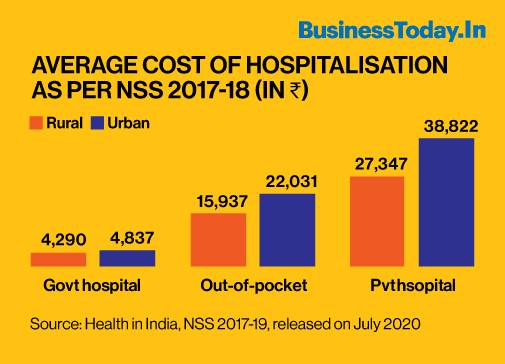
The following graph captures the latest official data of the National Sample Survey (NSS) of 2017-18, released in July 2020, showing how the average cost of hospitalisation in private sector is 6 to 8 times higher than government hospitals and out-of-pocket expenditure constitutes more than half of private hospitalisation cost.
India is perhaps the only country in the world where even public healthcare entails "catastrophic" out-of-pocket expenditure. The 2015 draft National Health Policy said "almost all hospitalisation even in public hospitals leads to catastrophic health expenditures" and that "there is no financial protection for the vast majority of healthcare needs.
Even the fully-paid government-run health insurance scheme Ayushman Bharat (PM-JAY) entails out-of-pocket expenditure. (For more read 'Coronavirus Lockdown VI: How India's insurance-led private healthcare cripples its ability to fight COVID-19')
The Ayushman Bharat scheme was launched in 2018 to provide free healthcare to bottom 40% of the population. In January 2020, the Indian Medical Association, the apex body of medical professionals in India, issued a public statement which said: "Ayushman Bharat, the flagship of the current government, is a non-starter and operates more in government hospitals where treatment is already free. 15% of the money paid to hospitals, including government hospitals. is siphoned off by insurance companies..."
Dominant private sector on the fringe during crisis
India's private healthcare accounts for 70% of national healthcare needs and yet when the pandemic hit, almost all of private healthcare facilities shut down. Most of them remain shut even now. Those which have joined the fight have been forced under the emergency powers of the National Disaster Management Act of 2005, which provides for "compensation" for such work.
States like Maharashtra and Bihar have to repeatedly threaten private healthcare to provide non-COVID-19 treatment and yet there is little progress, forcing medical experts and civil society to issue almost daily appeals. (For more read 'Coronavirus Lockdown XI: Why India's health policy needs a course correction ')
The national crisis hasn't stopped private healthcare from profiteering either. Earlier this month, Karnataka's health minister threatened a private hospital for giving an estimate of Rs 9 lakh to treat breathlessness. This is for illustration purpose, for such cases abound.
Concerned citizens have approached the Supreme Court (SC) but that hasn't helped so far. In April, it did direct private path labs to test COVID-19 cases for free but quickly retracted. On that occasion, solicitor general Tushar Mehta and former attorney general Mukul Rohtagi had assured the apex court that the government was doing all that was needed to care for the vulnerable.
On July 14, the top court heard another petition seeking a cap on COVID-19 treatment cost in private hospitals because of frequent complaints of "exorbitant" costs. The court is reported to have said that their exorbitant costs "must not dissuade patients" and asked petitioners and representatives of private hospital associations to meet health ministry officials to resolve the issue of hospitalisation cost."
Two facts are relevant here.
One, solicitor general Tushar Mehta told the court that the government had already put a cost fixation mechanism in place which varied from state to state. This is true.  
For example, on June 19, following complaints of fleecing by private hospitals in Delhi, the Ministry of Home Affairs (MHA) slashed charges by one-third. The new rates ranged from Rs 8,000 (isolation bed) to Rs 18,000 (ICUs with ventilator) per day. On June 6, Tamil Nadu had already capped per day general ward cost at Rs 7,500 and ICU cost at Rs 15,000 for private hospitals.
It is unlikely the Supreme Court was unaware of this.
It is also unlikely that the court didn't know about the NSS's 2017-18 consumption expenditure survey, which revealed that 'real' monthly household consumption (MPCE) had fallen for the first time in four decades from Rs 1,501 in 2011-12 to Rs 1,446 in 2017-18. The report wasn't officially released for its critical findings but it did hit the headlines across media through a 'leaked' report.
The question that arises here is: If the average monthly household expenditure (MPCE) - a proxy for monthly average income level of households in India since India does not measure household incomes - is Rs 1,446, how many Indians can afford a daily healthcare cost of Rs 7,500 to Rs 18,000 - 5 to 12 times their monthly income?
The amount of Rs 1,446 may be for 2017-18 but there is no credible evidence to say this has gone up in subsequent years. Secondly, loss of jobs and income has hit astronomical levels due to the prolonged lockdown, impoverishing millions of Indians. Thirdly, India's GDP growth has fallen from 8.1% in Q4 of FY18 to 3.2% in Q4 of FY20.  
A global study suggests the lockdown could impoverish 352 million to 528 million Indians. The government is not even tracking job and income losses at this hour due to health and economic crises.
Should then "exorbitant cost" of private healthcare not provoke the Supreme Court to put breaks?
Pharmaceutical companies, patents and organised crime
There is another serious aspect to private sector in healthcare.
Private pharmaceutical companies are particularly notorious for profiteering from human misery. There is plenty of literature and historical evidence for this. Here are some lesser-known facts and information.
On May 27, Washington Post carried a news piece headlined "Taxpayers paid to develop remdesivir but will have no say when Gilead sets the price". Remdesivir is an antiviral drug which has emerged as a potential candidate for COVID-19 treatment and is being tested for efficacy. It has been found to reduce hospitalisation period by a few days. Gilead Sciences is the pharmaceutical company that makes it.
The report explained that several years ago when Remdesivir was being developed as an antiviral drug "three federal health agencies" provided "tens of millions of dollars of government research support" to it.
It further pointed out: "Despite the heavy subsidies, federal agencies have not asserted patent rights to Gilead's drug (Remdesivir), potentially a blockbuster therapy worth billions of dollars. That means Gilead will have few constraints other than political pressure when it sets a price in coming weeks. Critics are urging the Trump administration to take a more aggressive approach."
The report quoted Lloyd Doggett (D-Tex.), chairman of the House Ways and Means health subcommittee saying: "Without direct public investment and tax subsidies, this drug would apparently have remained in the scrapheap of unsuccessful drugs."
Gilead acknowledges it, but says "the original compound was discovered" by it and hence its proprietorial claim (to fix the price).
Here are a few other examples from Stiglitz's book, 'People, Power and Profits' for more light.
Taking about "stealth theft" by pharmaceutical companies in supplying drugs to the US government, Stiglitz writes: "The pharmaceutical companies put a little provision in the law providing the elderly with drugs under Medicare: the government, the largest buyer of drugs in the world, was not allowed to bargain on price. This and other provisions were put in at the behest of the drug companies to generate higher prices and profits."  
He goes on to add: "It worked. Medicare drugs cost far more than those provided, say, by other government programs, like Medicaid for the poor or those for veterans. For the same brand-name drugs, Medicare pays 73 percent more. The result is that every year, taxpayers' fork over tens of billions of additional dollars to the drug companies."
Stiglitz narrates how big pharma companies use patent and other laws to keep cheap generic drugs out of market, often with the US government help, to make higher profits at the cost of consumers and government.
One method is to introduce a "time-release version" of an existing drug before its patent expires to extend the patent protection and prevent its generic versions to emerge. The "time-release version" (drug released in small amount over a time period) is not a new drug but by way of legal provisions called "data exclusivity" the relevant data on the original drug is restricted to prevent generic versions.
He cites some specific instances. For instance, Turing Pharmaceuticals increased the price of Daraprim, an out-of-patent drug, in 2015 from $13.5 a tablet to $750 a tablet. Another major company Valeant, the only FDI-approved manufacturer of the out-of-patent drug Syprine, a life-saving drug for a rare liver condition, "which sells for a dollar in some countries" so that a year's supply cost $300,000 by using its market power in 2015.    
How allowing generic drugs helps can be revealing. Here is a case of India.
In 2012, Hyderabad-based Natco Pharma got "compulsory license" to make a generic version of anti-cancer drug Nexavar sold by Germany's manufacturer Bayer bringing down a month's cost of the drug from Rs 2,84,428 to Rs 8,800.  
That could happen because (i) Bayer did not start producing the drug in India within three years of getting a licence as was required under the Indian Patents Act of 1970 but continued to import it and (ii) the WTO allows such a move on humanitarian grounds.
India's reverse journey: from self-sufficient to import-dependent
India's negligence of public sector pharmaceutical companies has turned it from self-sufficiency to important-dependent. India imports two-thirds of its active pharmaceutical ingredients (API) and formulations from China (the trade war has disrupted it now).
Two key public sector companies, Indian Drugs and Pharmaceuticals Ltd (IDPL) and Hindustan Antibiotics Ltd (HAL), have turned sick due to prolonged negligence. Last year the central government decided to close down IDPL and its subsidiary Rajasthan Drugs and Pharmaceuticals Ltd (RDPL) and sell off HAL and Bengal Chemicals and Pharmaceuticals Ltd (BCPL).
Such negligence by the government and profit-driven operation of private sector has led to the disappearance of cheap and antibiotic wonder drug penicillin from India.  
HAL was set up in 1950s to produce penicillin commercially. When, in late 2019, the Indian government wanted to produce it again, the HAL expressed its inability. While penicillin is a key element of treatment in the UK's healthcare system, it can't be found in India. No private sector pharma company is interested in producing cheap drugs, their usefulness notwithstanding.
India largely depends on China for the supply of Penicillin G to use it as a raw material for manufacturing antibiotics. (For more read 'Coronavirus Lockdown VII: What India can learn from COVID-19 hit nations ').
DO YOU LIKE THIS STORY?
 2  0

Rebooting Economy 70: The Bombay Plan and the concept of AatmaNirbhar Bharat

  The Bombay Plan, authored by the doyens of industry in 1944 first envisioned state planning, state ownership and control of industries to ...