Thursday, February 28, 2019

No silver bullet solution to agrarian distress

There is, however, no silver bullet solution to agrarian distress. It needs long-term planning and multi-pronged strategy.

twitter-logoPrasanna Mohanty | January 21, 2019 | Updated 21:40 IST
Farm loan waiver: Majority and poorest farmers do not benefit - a status check

Agrarian distress has come to the centre stage of national discourse primarily because of last year's multiple farmers' marches and the electoral outcomes in the three Hindi heartland states of Rajasthan, Madhya Pradesh and Chhattisgarh. This augurs well for a sector which provides 49% of total employment and supports nearly 70% of population but has largely been relegated to the background.

However, much of the debate is centred around politically expedient and populist measures like farm loan waiver, higher minimum support price (MSP) and of late, investment support for farmers in line with Telangana's popular Rythu Bandhu (Agriculture Investment Support Scheme). What needs to be understood is that agrarian distress did not happen overnight. Niti Aayog's 2017 report, Doubling Farmers' Income,  and many such analyses, state clearly that the problems started after 1991-92 - until when both farm and non-farm sectors grew at the same level - and so requires a comprehensive approach to pull the sector out of the crisis.

Here we take a look at some of the solutions being bandied about these days.

Loan waiver helps a minority, excludes landless

Farm loan waiver is no panacea, but an emergency relief for some farmers, not all. That is because it benefits only those farmers who have taken loans from institutional sources. Last NSSO survey of 2013 showed 52% of agriculture households were indebted but only 60% of those had taken loans from institutional sources.  This means, only 31% agriculture households (60% of 52% indebted households) are likely to benefit from loan waiver.

Also read: Farm Loan Waiver Is Not The Answer

A NABARD study of 2015-16  also reflects similar situation. It says 43.5% of farm households took loans that year (though 52.5% were indebted at the time); 60.4% of which had sourced it from institutional sources and 9.2% from both institutional and non-institutional sources. This too brings the likely beneficiaries of loan waiver to about 30% agriculture households (69.6% of 43.5%).


What remain hidden from such calculations are the landless households - the poorest of the poor - who don't benefit from farm loan waiver at all. Their number is shocking: 56.41% of total rural households or 101 million households were landless in 2011, as per the Socio Economic and Caste Census.  Further, Agricultural Statistics of 2017  says agriculture is now dominated by farm labourers, not cultivators - there were 144.3 million farm labourers (or 54.9% of total agriculture workforce), against 118.8 million cultivators (45.1% of total) in 2011. Their number has steadily grown since 1951 when they constituted a mere 28.1%.


Higher MSP and Bhavantar Bhugtan too benefit a minority

As the Shanta Kumar committee pointed out in 2015,  only 6% farmers directly gain from selling paddy and wheat to the government agencies. It benefits only those with marketable surplus, not all farmers. Worse, 2018 saw markets crashing after higher MSPs were announced in both kharif and rabi seasons. Last October, the prices of cereal, paddy, oilseed and cotton crashed in more than 1,700 markets. This highlighted failure of market reforms like e-NAM (online trading platform).

It is in this context that Madhya Pradesh's Bhavantar Bhugtan Yojana (BBY) - in which farmers directly get the difference between MSP and market price in case of a crash - gained respectability until it was found that traders, more than farmers, benefited from it and was abandoned, only to be resurrected ahead of the last elections. Thus, higher MSP and BBY have their limitations too.

Investment support scheme/Rythu Bandhu: Its efficacy is untested

The Telangana Rashtra Samiti's dramatic performance in the last elections has brought its innovative Rythu Bandhu scheme of 2018 - the first direct farmer investment scheme in India - to the limelight and there is a rush of the state governments to adopt it. The Central government too is understood to be working towards such a scheme ahead of the next general elections.

Under the Rythu Bandu scheme, Telangana provides Rs 8,000 per acre per year (now increased to Rs 10,000) - but nothing to the landless or tenant farmers. While its efficacy and adequacy (Rs 833 per month) are yet to be tested or studied, its perceived electoral dividend is very high. Odisha, West Bengal and Jharkhand have now started similar schemes. While West Bengal and Jharkhand have more or less adopted the Telangana formula, Odisha has gone a step ahead by declaring Rs 12,500 for the landless families per annum, in addition to Rs 10,000 per year for all small and marginal farmers.

Another issue is fiscal space, given the tight fiscal situation. Various estimates show a Rythu Bandhu- like scheme for the country would cost between Rs 1.97 to 3 lakh crore. A study by SBI says if Rs 12,000 per year is given to small and marginal farmers (43 million families), it would cost Rs 50,000 crore per year.

The trouble with all these calculations, however, is that tenant farmers and landless/farm labourers who form more than 50% of the total agriculture workforce are completely left out.

Investment is abysmally low and falling

One of the biggest challenges facing agriculture is abysmally low and steadily falling investment levels. According to Agricultural Statistics of 2017, while public investment in agriculture has remained between 0.3% and 0.4% of GDP between 2011-12 and 2016-17, private investment has declined from 2.7% to 1.8% of GDP during the same period - pulling down total investment (both public and private) from 3.1% of GDP 2011-12 to 2.2% in 2016-17.


Given the fact that agriculture provides nearly half of country's employment and supports more than three-fourth of population, such investments are too little to have an impact.

No silver bullet solution

Experts offer many solutions. One SBI research paper favours a hybrid model - higher MSP with price compensation mechanism like BBY.  Agricultural economist Ashok Gulati says investment support/income transfer scheme is the best way to help farmers. Soumya Kanti Ghosh, chief economic adviser of SBI, thinks income support is a better option than loan waivers but may be a worse solution than freeing up agri trade and marketing. Arvind Panagariya, economist and former Niti Aayog vice chairman suggests creating more jobs in industry and services to absorb excess labour in agriculture.

There are standard textbook solutions too: increasing productivity outside the green revolution states, value additions, crop diversification, use of technology and innovation, expansion of irrigation, land reforms, land and labour pooling etc.

What is obvious is that there is no silver bullet solution. Given the long-term distress in agrarian economy and its pervasiveness, the solution needs to be long-term and multi-pronged. Short cuts or populist measures are unlikely to have a lasting or meaningful impact.

Graphic visualisation by Namrata Dadwal

Also read: Farm loan waivers to increase states' fiscal deficit in the election year: India Ratings

DO YOU LIKE THIS STORY?

 9  0


Thursday, January 31, 2019

2019 (missing) report: Government needs to release job data

Suppression of unemployment survey data, howsoever unpleasant, is not only undesirable, it is counter-productive.

ADVERTISEMENT
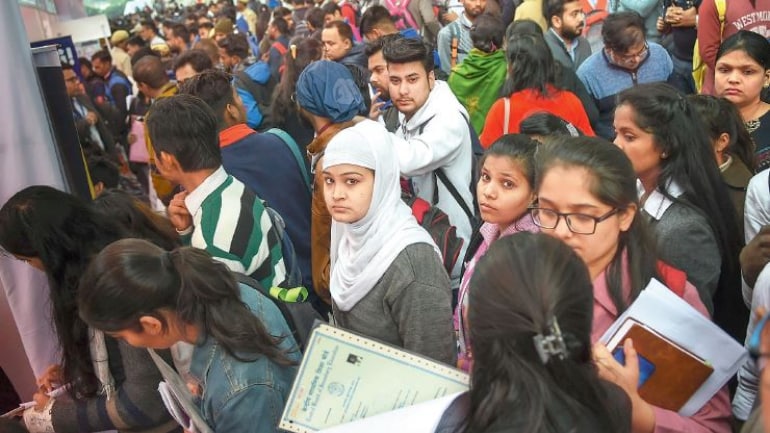
Aspirants stand in queues during a job fair in New Delhi.

The sudden resignations of two non-government members of the National Statistical Commission an autonomous body supervising statistical reporting by the government brings into sharp focus the Central government’s persistent attempt to suppress inconvenient truth about high unemployment in the country.

Suppression of unemployment survey data, howsoever unpleasant, is not only undesirable, it is counter-productive. Periodic data not only provides timely insights into the workings of the job markets and brings out different dynamics at play; it also helps in making intelligent policy and strategic decisions to overcome the situation.

SHARP RISE IN UNEMPLOYMENT

Even in absence of official data, it is widely known that unemployment has risen sharply in the past few years because of decisions like demonetisation and shoddy implementation of a badly designed GST, apart from factors that may be beyond the government’s control.

The ILO’s World Employment and Social Outlook: Trends 2018 report paints a gloomy picture. It says unemployed in India is expected to rise from 18.3 million in 2017 to 18.6 million in 2018 and 18.9 million by 2019.

But the numbers are likely to be far worse because its estimates are based on an unemployment rate of 3.5 percent, while the withheld 6thEmployment-Unemployment Survey (EUS) 2016-17 reportedly shows that it has gone up to 3.9 percent. Even the fifth EUS of 2015-16 had shown an unemployment rate of 3.7 percent much higher than that of ILO’s.

GOVERNMENT’S RESPONSE DISAPPOINTING

Having promised to create 10 million jobs every year before coming to power, the current dispensation has miserably failed to live up to it. Several of its employment-generating programmes have turned nonstarters. For example, the MUDRA loan scheme (started in 2015) was touted as a big initiative to generate self-employment, but closer scrutiny reveals it has neither improved credit flow to the MSMEs nor able to deploy funding available to it (with 40 percent lying idle).

ADVERTISEMENT

The Start-up India scheme was announced with lofty claims of setting aside `10,000 crore for boosting capital flow to start-ups and SMEs in 2014. Nearly five years down the line, the official data shows only 72 start-ups were sanctioned `605 crore. Interestingly, this data was last updated in September 15, 2017. The Skill India programme is now a forgotten slogan, having failed to address the skilling needs of industries or jobs to the skilled. So is the case with the other big-bang initiative, Make in India.

In sheer desperation, the government started peddling EPFO numbers as evidence of new job creation, forgetting that this data is part of its job formalisation drive called Pradhan Mantri Rozgar Protsahan Yojana (PMRPY) the government paying full employers’ contribution of 12 percent towards Employees’ Provident Fund and Employees’ Pension Scheme for new employees since April 2016. This is not the same as new jobs as people switch jobs, duplicat-Govt needs to release job data Aspirants stand in queues during a job fair in New Delhi. ing EPF numbers. Old employment guarantee scheme, NREGA, which was disdainfully dismissed as a living monument to UPA’s failure, is the only saviour, continuing to provide 40-50 days of work to 4-5 crore households every year.

WHY JOB DATA IS NECESSARY

A reading of the quarterly reports on the employment scenario (QES), which too have been discontinued by the government, provides several insights into the job market. For example, such reports from 2009 to 2017 shows that certain sectors like construction and IT/BPO which were providing a bulk of employment for years stopped doing so in 2016 and 2017. Similar is the case with labour intensive sectors of leather, gems and jewellery, transport and handloom. On the other hand, more jobs are being created in health, education, trade, accommodation and restaurant sectors.

WHAT THE GOVERNMENT SHOULD BE DOING

What the government has not denied is that 12.8 million youth are joining the labour force every year. So, ideally, new livelihood opportunities should be created to that extent. But how to do that continues to remain a big challenge. It should release the job data, discuss and debate the findings, consult relevant stakeholders and prepare appropriate policy response and strategies to address the growing unemployment.


Wednesday, January 30, 2019

2019 reports (missing) In-depth: Why Rahul Gandhi's minimum income promise can be a reality & Universal Basic Income: Will it work in India?


In-depth: Why Rahul Gandhi's minimum income promise can be a reality

NPAs being written off and revenue being foregone every year for India's rich can easily fund Minimum Income Guarantee scheme

twitter-logoPrasanna Mohanty | January 30, 2019 | Updated 16:33 IST
In-depth: Why Rahul Gandhi's minimum income promise can be a reality

Congress President Rahul Gandhi's unexpected announcement promising a "minimum income guarantee to every poor" may have stumped many, but this is probably the idea whose time has come - to borrow Victor Hugo's words famously quoted by former Prime Minister Manmohan Singh while unleashing the liberalisation process in his 1991 budget.

That is because the world is experimenting with the idea of income redistribution in a big way for the past few years to overcome two major concerns of our time: vast and growing inequality and the threat of automation creating joblessness. India's concerns are no different. In fact, growing income inequality and unemployment are the two major concerns that the Indian policymakers need to confront but go abegging.

The basic idea of minimum income guarantee (MIG) is to provide income support to vulnerable people and families to ensure a life with dignity. In Rahul Gandhi's scheme of things, this is clearly meant for all poor - presumably, all those who fall below the poverty line. A clear picture would emerge once the details are unveiled.

NDA'S UBI vs Rahul Gandhi's MIG

Rahul Gandhi's announcement adds a twist to the debate on universal basic income (UBI) first mooted by the Economic Survey of 2016-17. The basic premise of the Economic Survey's UBI was: "A just society needs to guarantee to each individual a minimum income which they can count on, and which provides the necessary material foundation for a life with access to basic goods and a life of dignity".

The Economic Survey's plan was to provide Rs 7,620 per annum - Tendulkar's poverty line of 2011-12 was inflation-indexed to 2016-17 - to 75% of population. It said this would cost 4.9 per cent of GDP, which could be funded from 5.2 per cent of GDP allocated for 950 central sector and centrally sponsored sub-schemes in 2016-17.

In contrast, Rahul Gandhi's plan seems to target only the poor (whether he means 22% of population fixed as poor by Tendulkar or 29.5 per cent fixed by Rangarajan is not yet clear) and his "minimum income" has not been declared.

Poverty estimation by Tendulkar and Rangarajan

The difference between UBI and MIG is this: A basic income is generally understood as the poverty line (as do the Economic Survey and economists world over assume), while a minimum income is pretty much at one's discretion - equal, more or less than the poverty line expenditure.

Growing inequality and unemployment

While the Central government has stopped publishing employment data, ILO's 2018 World Employment and Social Outlook Trends says the number of India's unemployed is expected to rise from 18.3 million in 2017 to 18.6 million in 2018 and 18.9 million by 2019, at 3.5 per cent unemployment rate for each year. Newspaper reports say that the 6th Employment-unemployment Survey of 2016-17, which has been withheld by the government, shows the unemployment rate shot up to 3.9 percent - up from 3.7 percent in 2015-16 and 3.4 percent in 2013-14. This would mean a much higher unemployment number than the ILO's.

Every year, 12.8 million youth are joining the labour force looking for work. But such is the situation that in 2018 alone, 11 million jobs were lost - as the CMIE survey has shown.

As for inequality, French economists Thomas Piketty and Lucas Chancel have shown in their 2017 study, Indian Income Inequality, 1922-2015: From British Raj to Billionaire Raj? that India is more unequal now than any time since the British Raj and that the top 1 percent of earners capture 22 percent of total income".

The latest Oxfam International report says, 136 million Indians, who make up the poorest 10 percent of the country, have continued to remain in debt for the past 15 years; in 2018 alone, India's 119 billionaires saw their wealth mushrooming by Rs 2,200 crore a day on average. Oxfam's executive director found this "morally outrageous" and warned: "If this obscene inequality between the top 1 percent and the rest of India continues then it will lead to a complete collapse of the social and democratic structure of this country."

Selecting the poor and finding funds

Two questions have cropped up since Rahul Gandhi made his MIG announcement: One, how to select the beneficiaries and two, whether India's fiscal situation will allow this. The first one is easy to answer: The same way the Ayushman Bharat selects its beneficiaries - from the list of the Socio-Economic and Caste Census of 2011.

The answer to the second one would have to wait until Rahul Gandhi tells us his "minimum" amount.

But assuming that he would follow the Tendulkar formula, that is 22 percent of population as poor, and that they are to be given Rs 7,620 per annum in line with UBI, it would cost about 1.43 percent of GDP (since it costs 4.9 percent of GDP for covering 75 percent of population as per the Economic Survey's calculations) or Rs 1,99,511 crore  -  Rs 139,51,849 crore (size of GDP as per the advance estimate for 2018-19) multiplied by 1.43 percent.

Where would that money come from?

Well, one source could be the one that the government and RBI find every year to write off corporate loan defaults - better known as the non-productive assets (NPAs) - and "revenue foregone" in the budget for the corporate tax payers.

According to the RBI's report, Operations and Performance of Commercial Banks, Rs 108,500 crore and Rs 162,700 crore of NPAs were written off in 2016-17 and 2017-18, respectively.

Similarly, the revenue foregone was Rs 86,145 crore in 2016-17 and Rs 85,026 crore in 2017-18.

NPAs written off and revenue foregone for past two years

Taken together, Rs 194,645 crore in 2016-17 and Rs 247,726 crore in 2017-18 were written off up as NPAs and given up revenue foregone for the rich Indians - more than what MIG would cost for the poor Indians!

There are other ways to find funds too. As economist Pranab Bardhan has suggested, tax wealth, inheritance and long term capital gains and collect more tax from under-assessed/under-taxed property. That should be enough.

Just one caution: Whether UBI or MIG, don't fund it from the expenditure on 950 central schemes. These schemes include those of food subsidy, fertiliser subsidy, NREGA, SSA, LPG subsidy, awas yojana, gram sadak yojana, ICDS, Swachh Bharat, Mid-day meals etc. In other words, those are meant for long-term human development (health, education) and rural infrastructure (roads, housing) and can't be substituted with UBI or MIG.

Not at least so long as India remains at the bottom-pile in human development index and per capita income. Currently, India ranks 130th out of 189 countries in the UNDP's 2018 HDI ranking. Once India come out of the low income trap, then such schemes could replaced with cash transfers.

Also read: Modi govt likely to make big announcement for farmers! Here's what you can expect

Also read: PM Modi memorabilia put on sale for 'Namami Gange' project; check out items on offer

Also Read: Tamil Nadu, Andhra Pradesh lag behind Haryana in girl sex ratio at birth

DO YOU LIKE THIS STORY?
 3  6

Universal Basic Income: Will it work in India?

The idea of UBI is not new but in the past few years, it has resurfaced globally in a very big way as a means of redistributing income.

twitter-logoPrasanna Mohanty | January 29, 2019 | Updated 14:44 IST
Universal Basic Income: Will it work in India?

The central government is believed to be working on a universal basic income (UBI) scheme for the poor ahead of the General Elections. The Economic Survey of 2016-17 had first flagged the UBI as "a conceptually appealing idea" and a possible alternative to social welfare programmes targeted at reducing poverty.

What is UBI?

UBI is a fixed income every adult - rich or poor, working or idle - receives from government. The idea is that a society, as a first priority, should look out for its people's survival; the lesson is that possibly it can do so without unequal redistributive plans.

According to Basic Income Earth Network (BIEN), a global network of academics, students and social policy practitioners promoting and serving as a repository of published research on UBI, "A basic income is a periodic cash payment unconditionally delivered to all on an individual basis, without means-test or work requirement."

Why UBI?

The idea of UBI is not new but in the past few years, it has resurfaced globally in a very big way as a means of redistributing income. Several experiments/pilots are being currently run across the world, but not yet adopted by any country as such.

The primary reasons for the tilt towards UBI are two:

  • Growing and vast inequality
  • Threat of automation affecting jobs and creating joblessness

Some experts think the existing system "would falter and fail if confronted with vast inequality and tidal waves of joblessness." (Annie Lawrey, author of "Give People Money: How a Universal Basic Income Would End Poverty, Revolutionize Work, and Remake the World")

Basic premise of Economic Survey (ES) of 2016-17's UBI: "A just society needs to guarantee to each individual a minimum income which they can count on, and which provides the necessary material foundation for a life with access to basic goods and a life of dignity." Three components of this UBI model are: universality, un-conditionality and agency (by providing support in the form of cash transfers to respect, not dictate, recipients' choices). Its key features:

  • Poverty line for 2016-17 has been fixed at Rs 7,620 per year, using Tendulkar's poverty line formula (inflation indexing @ Rs 5,400 per year fixed for 2011-12 to 2016-17 with a target poverty level of 0.45%) to lift all poor above the Tendulkar poverty line.
  • It takes 75% of population as universal for UBI purpose.
  • Cost and fiscal space: ES model will cost 4.9% of GDP - as against 5.2% of GDP spent on all 950 central sector and centrally sponsored sub-schemes (actual allocation of 2016-17). So, fiscal space exists - but only if UBI replaces all existing Central govt. schemes.
  • Income transfer through DBT and by replacing all Central schemes, using Aadhaar.
  • Use gradualism - like starting with women, elderly, widows, disabled etc.

Also read: Modi govt likely to make big announcement for farmers! Here's what you can expect

Why Economic Survey model raises many questions

Economic Survey model is based on gross under-estimation of poverty. The Tendulkar's poverty line was criticised widely for gross under-estimation of poverty - per day per capita expenditure of Rs 27.2 in rural and Rs 33.3 in urban areas for 2011-12. It fixed 22% of population as poor. Therefore, C Rangarajan revisited it in 2014 and put poor families at 29.5% (363 million) - fixing per capita per day expenditure at Rs 32 in rural and Rs 47 in urban areas.

Niti Aayog Task Force on Elimination of Poverty report supports the Tendulkar's formula saying that the Rangarajan formula has not been officially accepted. In 2016, Niti Aayog justified this by saying:

(a) The sole objective behind the poverty line being to track progress in combating extreme poverty, it makes more sense to it at a level just sufficient for accessing the basic necessities of life; and (b) Setting the poverty line at a level at which the individual has comfortable existence will not allow us to assess the progress in the fortunes of those in abject poverty.

Table 1: Poor families in millions, % of total population and parameters


Source: Niti Aayog and other govt reports

UBI can't be at the cost of expenditure on health, education or rural infrastructure

  • 950 central sector and centrally sponsored sub-schemes include those of food subsidy, fertiliser subsidy, NREGA, SSA, LPG subsidy, Awas Yojana, Gram Sadak Yojana, ICDS, Swachh Bharat, Mid-day meals etc. These are meant for long-term improvement in human development, rural infrastructure, employment etc. and can't be substituted by cash transfer.
  • Therefore, replacing existing schemes with cash transfer will adversely impact the development goals of India.
  • India stood at 130 out of 189 countries in the UNDP's 2018 HDI ranking. Movement in the HDI are driven by changes in health, education and income.

India already has UBI-like scheme under which too little is paid, not hiked since 2006/7 - Under the National Social Assistance Programme (NSAP) since 1991, the Central government gives pensions to elderly, widows and disabled. The Centre's component is between Rs 200 and Rs 300.  If GOI is interested in UBI, it can easily begin by increasing the pension amounts.

Not tried anywhere with India's level of income disparity and inequality

India's experience with NSAP (given above) and DBT (details in the 'notes') is limited and unsatisfactory. Need for good pilots of sufficient time. India should join in carrying out large scale experiment/pilot like Finnish and Canadian - to generate empirical evidence.

  • Aadhaar-based DBT's flaws: Exclusion and authentication errors leading to starvation deaths in Jharkhand and other such experiences elsewhere.

Also read: PM Modi memorabilia put on sale for 'Namami Gange' project; check out items on offer

Tamil Nadu, Andhra Pradesh lag behind Haryana in girl sex ratio at birth

DO YOU LIKE THIS STORY?
 12  54

Rebooting Economy 70: The Bombay Plan and the concept of AatmaNirbhar Bharat

  The Bombay Plan, authored by the doyens of industry in 1944 first envisioned state planning, state ownership and control of industries to ...